Showing posts with label Mini Cooper. Show all posts

Mini Cooper Latest Photos

Mini Cooper
Mini Cooper

Mini Cooper Latest Photos

Mini Cooper
Mini Cooper

Mini Cooper The Best Cheap Car


Mini Coopermini cooper car
Mini Coopermini cooper review
Mini Coopermini cooper photo
Mini Coopermini cooper image
Mini Coopermini cooper classic car

Mini Clubman and Mini 1275GT (1969–1980) Parts 3

MINI Cooper

Mini Clubman and Mini 1275GT (1969–1980) Parts 3


Mini Clubman and Mini 1275GT (Mini Cooper Cars)
Picture Of

Mini Clubman And Mini 1275GT

Classic MINI Cooper Cars

MINI Cooper Cars

The Mini Clubman and 1275GT were responsible for two motoring "firsts": they were the first vehicles to use a flexi printed-circuit board behind the dash instruments (universal nowadays, but technically advanced for 1969). Secondly, the 1275GT was the first vehicle to be offered with run-flat tyres; from 1974 this model could be ordered with optional Dunlop Denovo tyres on 12-inch (300 mm) diameter rims. In the event of a puncture, the Dunlop Denovo tyre would not burst and quickly deflate, but could continue to be used safely at speeds of up to 50 mph (80 km/h). This was a useful safety feature, although the increased road noise and relatively poor grip of this tyre meant that many 1275GT buyers ignored this option.
Mini Clubman and Mini 1275GT (Mini Cooper Cars)
Picture Of

Mini Clubman And Mini 1275GT


Throughout the 1970s, British Leyland continued to produce the classic 1959 "round-front" design, alongside the newer Mini Clubman and Mini 1275GT models. The long-nose Clubman and 1275GT offered better crash safety, were better equipped, and had vastly better under-bonnet access, but they were more expensive and aerodynamically inferior to the original 1959 design. The Clubman and 1275GT were replaced in 1980 by the new hatchback Austin Metro, while production of the original "round-front" Mini design continued for another 20 years. At the end of Mini Clubman and Mini 1275GT production, 275,583 Clubman saloons, 197,606 Mini Clubman Estates and 110,673 Mini 1275GTs had been made.


related : Mini Mark II ~ Mini Classic Cars (1967–1973)
related : Mini Clubman And Mini 1275GT ~ MINI Cooper Parts 1 And Parts 2

MINI Cooper Cars Models Mini Clubman and 1275GT: 1969–1980 Parts 2

MINI Cooper Cars Models Mini Clubman and 1275GT: 1969–1980 Parts 2


Classic MINI Cooper Cars Models Mini Clubman and 1275GT
Picture Of

MINI Cooper Cars


Classic MINI Cooper Cars

MINI Cooper Cars Parts 1

The 1275GT is often incorrectly described as the "Mini Clubman 1275GT". The official name was always just the "Mini 1275GT", and it was a separate, distinct model from the Mini Clubman (albeit, it shared the same frontal treatment as the Mini Clubman, and was launched at the same time).

In 1971, the 1275 cc Mini Cooper S was discontinued in the UK, leaving the Mini 1275GT as the only sporting Mini on sale for the rest of the decade. Innocenti in Italy, however, continued making their own version of the Mini Cooper for some time. While the UK built 1275GT was not nearly as quick as a 1275 Mini Cooper S, it was cheaper to buy, run, and insure. It was the first Mini to be equipped with a tachometer. It also featured a standard-fit close-ratio gearbox. Performance of the 1275GT was lively for the time, achieving 0–60 mph (97 km/h) in 12.9 seconds, and the excellent midrange torque offered a 30–50 mph (48–80 km/h) time in top gear of only nine seconds. The bluff front, however, meant that the model struggled to reach 90 mph (140 km/h). The 1275 cc A-series engine could be cheaply and easily tuned, though the cheap purchase price and prominent "sidewinder" door stripes meant that this model developed a reputation as something of a "boy-racer special" during the 1970s and into the 1980s.


Used Classic MINI Cooper Cars Models Mini Clubman and 1275GT: 1969–1980 Parts 1

Used Classic MINI Cooper Cars Models Mini Clubman and 1275GT: 1969–1980 Parts 1


MINI Cooper Cars Models Mini Clubman and 1275GT
Picture Of

MINI Cooper Cars


Classic MINI Cooper Cars// MINI Clubman

MINI Cooper Cars And MINI Clubman Parts 1

In 1969, under the ownership of British Leyland, the Mini was given a facelift by stylist Roy Haynes, who had previously worked for Ford. The restyled version was called the Mini Clubman, and has a squarer frontal look, using the same indicator/sidelight assembly as the Austin Maxi. The Mini Clubman was intended to replace the upmarket Riley and Wolseley versions. A new model, dubbed the 1275GT, was slated as the replacement for the 998 cc Mini Cooper (the 1275 cc Mini Cooper S continued alongside the Mini Clubman 1275GT for two years until 1971). The Mini Clubman Estate took over where the Countryman and Traveller left off.

However, British Leyland continued to produce the classic 1959 "round-front" design, alongside the newer Mini Clubman and Mini Clubman 1275GT models (which were replaced in 1980 by the new hatchback Austin Metro, while production of the original "round-front" Mini design continued for another 20 years.)

Production of the Mini Clubman and Mini Clubman 1275GT got off to a slow start because the cars incorporated "lots of production changes" including the relocation of tooling from the manufacturer's Cowley plant to the Longbridge plant: very few cars were handed over to customers before the early months of 1970.

Early domestic market Mini Clubman were still delivered on cross-ply tyres despite the fact that by 1970 radials had become the norm for the car's mainstream competitors. By 1973 new Minis were, by default, being shipped with radial tyres, though cross-plies could be specified by special order, giving British buyers a price saving of $8. ~ MINI Cooper Cars Models Mini Clubman and 1275GT


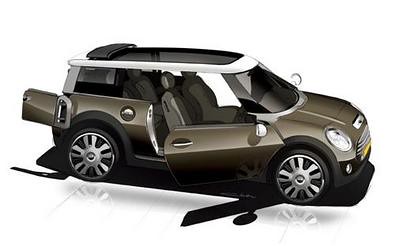
Mini Cooper Concept cars 2011

mini cooper picturesmini cooper concept cars
mini coopermini cooper
Mini Coopermini cooper s conv 530
Mini Coopermini cooper swarovski
Mini CooperCooper S 50 Camden
Mini Cooper1977 Mini Cooper Green Racing
2011 Mini CooperPics Mini Cooper Concept

Mini Cooper Classic Cars - Morris Mini K

Morris Mini K (March 1969 – August 1971, Australia only)


The Mini is a small car that was made by the British Motor Corporation (BMC) and its successors from 1959 until 2000. The original is considered a British icon of the 1960s, and its space-saving front-wheel-drive layout (that allowed 80% of the area of the car's floorpan to be used for passengers and luggage) influenced a generation of car-makers. The vehicle is in some ways considered the British equivalent to its German contemporary, the Volkswagen Beetle, which enjoyed similar popularity in North America. In 1999 the Mini was voted the second most influential car of the 20th Century, behind the Ford Model T.

Mini Cooper Classic Cars


Built in the Australian British Motor Corporation factory at Zetland, NSW using 80% local content, the Morris Mini K was advertised as the "great leap forward". The Mini K ('K' standing for Kangaroo) had a 1098 cc engine and was the last round-nose model to be produced in Australia, originally priced at $1780 (AUD).


Mini Cooper Images Gallery

Mini Coopermini cooper r56
Mini Coopermini cooper
Mini Coopermini cooper image
Mini Coopermini cooper 2005
Mini Coopermini cooper gp kit
Mini Coopermini cooper
Mini Coopermini cooper clubman

Mini John Cooper Works Convertible


Cute only goes so far. Fast and cute goes a lot farther (comments posted about girls you knew in college will be deleted upon reciept).

But fast and cute will cost you money, just like that girl in college (I'm invoking one-time editor/founder privilege).

This is the story of the Mini John Cooper Works Convertible. Its base price is $10,000 and change more than a base Mini Cooper Convertible, but that ten grand buys you the difference between 118 horsepower and 208....between a top speed of 123 and a top speed of 146...while giving up only 3 miles per gallon in both city and highway fuel economy (the EPA says 25 city/33 highway).


It also gets you a six-speed manual Getrag transmission, 17 inch alloy wheels with run-flat tires, and red Brembo front brake calipers. All of which covers going and stopping. And it handles like a slot car.


Inside, it's six-way adjustable sport seats with height adjustment, an on-boarad computer, a leather three-spoke steering wheel and the Sport button...which produces quicker throttle and steering response....neither of which was in short supply to begin with.

This is one of those cars that will put a grin on your face that will take days to go away.

No, $34,700 for a Mini convertible isn't cheap....nor is the $38,400 as-tested price (Mini threw in a cold weahter package, premium package with alarm, automatic air conditioning and chrome interior and exterior accents), Xenon headlights, custom paint, a Bluetooth and USB/iPod adapter (frankly, Mini's got....what's the German word for cojones?...charging $500 for that piece...which most automakers are including free of charge)...and white turn signal lights ($100? Really?) .

But find another convertible with this blend of speed, handling and fuel economy...and then find one anywhere near $38,400....much less $34,700.

A truly exciting car today...and, because it's likely to sell in smallish numbers, a collector's performance machine you'll be glad you kept years from now.

Mini Classic Cars - Mini Moke (1964–1989)

Mini Classic Cars - Mini Moke (1964–1989)

Mini Classic Cars Picture Of Mini Classic Cars

A utility vehicle intended for the British Army, for whom a few twin-engined 4-wheel-drive versions were also built. Although the 4WD Moke could climb a 1:2 gradient, it lacked enough ground clearance for military use. The single-engined front-wheel-drive Moke enjoyed some popularity in civilian production. About 50,000 were made in total, from 1964 to 1968 in the UK, 1966 to 1982 in Australia and 1983 to 1989 in Portugal. The car featured in the cult 1967 TV series The Prisoner, and is popular in holiday locations such as Barbados and Macau, where Mokes were used as police cars. Mokes were also available to rent there as recently as March 2006. "Moke" is archaic British slang for a donkey.

Mini Classic Cars - Mini Van (1960–1982)

Mini Classic Cars - Mini Van (1960–1982)

Mini Classic Cars

A commercial panel van rated at ¼-ton load capacity. Built on the longer Traveller chassis but without side windows, it proved popular in 1960s Britain as a cheaper alternative to the car. it was classed as a commercial vehicle and as such carried no sales tax. A set of simple stamped steel slots served in place of a more costly chrome grille. The Mini Van was renamed as the Mini 95 in 1978, the number representing the gross vehicle weight of 0.95 tons. 521,494 were built. Despite this renaming, the motoring public continued to call it the Mini Van, as a result of which the class of vehicles known as minivans in other countries are referred to in Britain as MPVs.

Mini Classic Cars - Morris Mini Traveller and Austin Mini Countryman (1961–1969)

Mini Classic Cars - Morris Mini Traveller and Austin Mini Countryman (1961–1969)

Mini Classic CarsPicture Of Mini Classic Cars

Two-door estate cars with double "barn"-style rear doors. Both were built on a slightly longer chassis of 84 inch (2.14 m) compared to 80.25 inch (2.04 m) for the saloon.

Mini Classic CarsPicture Of Mini Classic Cars

The luxury models had decorative, non-structural wood inserts in the rear body which gave the car a similar appearance to the larger Morris Minor estate which had some of the look of an American-style 1950s Woodie. Approximately 108,000 Austin Mini Countrymen and 99,000 Morris Mini Travellers were built.

Mini Classic Cars - Wolseley Hornet and Riley Elf (1961–1969)

Mini Classic Cars - Wolseley Hornet and Riley Elf (1961–1969)

Mini Classic CarsPicture Of Mini Classic Cars

Built as more luxurious versions of the Mini, both the Wolseley Hornet and the Riley Elf had longer, slightly finned rear wings and larger boots that gave the cars a more traditional "three-box" look. Front-end treatment, which incorporated each marque's traditional upright grille design, also contributed to a less utilitarian appearance. The cars had larger-diameter chrome hubcaps than the Austin and Morris Minis, and additional chrome accents, bumper overriders and wood-veneer dashboards. The Riley was the more expensive of the two cars. The name "Wolseley Hornet" was first used on a 1930s sports car, while the name "Elf" recalled the Riley Sprite and Imp sports cars, also of the 1930s. The full-width dashboard was a differentiator between the Elf and Hornet. This better dashboard was the idea of Christopher Milner the Sales Manager for Riley.

Mini Classic CarsPicture Of Mini Classic Cars

Both cars went through three versions. Initially, they used the 848 cc engine, changing to a single carburettor version of the Cooper's 998 cc power unit in the Mark II in 1963. The MKIII facelift of 1966 brought wind-up windows and fresh-air fascia vents; also concealed door hinges two years before these were seen on the mainstream Mini. 30,912 Riley Elfs and 28,455 Wolseley Hornets were built.

Mini Classic Cars - Mark II Mini (1967–1973)

Mini Classic Cars - Mark II Mini (1967–1973)

Mini Classic CarsPicture Of Mini Classic Cars

The Mark II Mini Classic Cars featured a redesigned grille which remained with the car from that point on. Also, a larger rear window and numerous cosmetic changes were introduced. 429,000 Mark II Minis were made.

Mini Classic CarsPicture Of Mini Classic Cars

A bewildering variety of Mini types were made in Pamplona, Spain, by the Authi company from 1968 onwards, mostly under the Morris name.

Mini Classic CarsPicture Of Mini Classic Cars

The Mini was arguably the star of the 1969 film The Italian Job, which features a car chase in which a gang of thieves drive three Minis down staircases, through storm drains, over buildings and finally into the back of a moving bus. This film was remade in 2003 using the new MINI.

mini cooper pics

You are invited to explore these web pages to find out more about the Mini Cooper Register. If you have any queries please email us - we will endeavour to answer your enquiry online but in some instances we may need to mail you directly so please quote a contact address in any communication. We update these pages on a monthly basis.

mini cooper picturesmini cooper wallpapers
2010 mini cooper2007 mini cooper
mini cooper wallpapermini cooper classic car
mini cooper reviewmini cooper kit car
mini cooper gallerymini cooper 2009
mini cooper conceptred mini cooper
mini cooper imagemini cooper image
mini cooper picsmini cooper 2005
mini coopermini cooper photo

Mini Classic Cars - Mark I Mini (1959–1967) The End Part

Mini Classic Cars - Mark I Mini (1959–1967) The End Part

Mini Classic Cars Picture Of Mini Classic Cars

From October 1965 the option of an Automotive Products (AP) designed four-speed automatic transmission became available. Cars fitted with this became the Mini-Matic

Mini Classic Cars Picture Of Mini Classic Cars

Slow at the outset, Mark I sales strengthened across most of the model lines in the 1960s, and production totalled 1,190,000. Sold at almost below cost, the basic Mini made very little money for its owners. However, it still did make a small profit. Ford once took a Mini away and completely dismantled it, possibly to see if they could offer an alternative. It was their opinion though, that they could not sell it at BMC's price. Ford determined that the BMC must have been losing around 30 pounds per car. BMC insisted that the way company overheads were shared out, the Mini always made money. Larger profits came from the popular De Luxe models and from optional extras such as seat belts, door mirrors, a heater and a radio, which would be considered necessities on modern cars, as well as the various "Cooper" and "Cooper S" models, to be discussed later.


Mini Classic Cars Picture Of Mini Classic Cars

The Mini etched its place into popular culture in the 1960s with well-publicised purchases by film and music stars.