Showing posts with label volvo. Show all posts

Volvo V60

 VOLVO
The Volvo V60 makes its entry onto the car market with its sights firmly set on giving the all-new S60 sedan model a tough match over the title of "The Most Dynamic Volvo Model Ever".
"Many of the customers who had an advance look at the new V60 during the development process feel that its attitude is at least as sporty as that of the all-new S60," says Volvo Cars Design Director Peter Horbury.
No less than 90 percent of the annual Volvo V60 production of 50,000 cars will find European buyers.

"The typical sports wagon customer is an S60 buyer who would like some extra space and flexibility, but without the slightest compromise on sporty design and exciting driving properties," says Volvo Cars President and CEO Stephen Odell, and adds:
"The competition is razor-sharp and the customers in this segment know exactly what they want. That is why we have further boosted the interior's sense of exclusive quality and packed the car with safety- and comfort-related technical innovations. The result is a truly unique sports wagon, in total harmony with its sporty attitude."
Coupe rather than estate car
The pronounced wedge shape and the slim coupe-like roof line of the new Volvo V60 are accompanied by the shoulder profile along the car's sides, creating a gentle yet powerful double wave from the headlamps at the front to the tail lamps at the rear.


"From the design viewpoint the focus was on making the car as close to a coupe as possible, while retaining that handy extra space at the rear. Our sports wagon does not aim to compete with the traditional estate car. For the customer who wants a lot of load space, there is our V70 or XC70," says Örjan Sterner, head of exterior design for the new Volvo V60. He adds: "The dip in the middle of the double wave visually pushes the car down. This enhances the stance and makes the car look sleeker and lower. The sculpted bonnet and the short overhangs front and rear also emphasise the sports car feel."

Siemens and Volvo Form Electric-Car Venture


German industrial conglomerate Siemens AG said Wednesday it has agreed with Sweden's Volvo Car Corp. on a strategic cooperation agreement on electric cars.

The focus will be on the joint development of electrical-drive technology, power electronics and charging technology as well as the integration of those systems into Volvo C 30 Electric cars, Munich-based Siemens said in a statement.

It added that the first vehicles will be on the test tracks at the end of this year.

Beginning in late 2012, Volvo will be delivering a test series of up to 200 vehicles to Siemens, which will then be tested as part of an internal Siemens test fleet, the German company said.

Volvo Car Corp. was last year acquired by China's Zhejiang Geely Holding Group Co. from Ford Motor Co.

For Siemens, the partnership is another step toward a greener image. Siemens touts itself as a pioneer in electric vehicles, and developed electric trams as early as the end of the 19th century.

Cooperations between companies are increasingly common in the development of environmentally friendly vehicles as a means to share the high entry costs and risks. General Motors Co. and LG Electronics Inc. also recently announced their partnership in the development of electric vehicles.

Peugeot Hoggar

Peugeot wants to establish itself as a leader in the manufacture of automobiles in general. To do this, we must work in all segments. And because Brazil is the largest market for compact pickups, was elected to the worldwide launch of the Hoggar, which arrives in dealerships May 15. Although not the mark of the first truck to be sold in the country – in 90 years, average of 504 have been imported from Argentina – Peugeot Hoggar entry in the fastest growing segment of the public services and is the largest sales .

The direction of the compact pickup is more than a decade with the Fiat Strada, followed by Volkswagen Saveiro, Chevrolet and Ford Courier veteraníssima Montana. That is, the French brand (one of the pioneers among the “newcomers” to land in Brazil for almost 20 years) just pick a fight against so-called “Big Four” the longest established brands in the market . Peugeot Hoggar Peugeot shows the ambition of accelerated internationalization and confirms strategy.Designed brand in Brazil for the Brazilian market, this pill is perfectly suited to the needs of local customers. Allows Peugeot to support and expand its status and its links as a local manufacturer.
First in the world, will revive the historic facility and Marque by the merger in the future. Peugeot Hoggar subtly combines the durability and reliability of the pickup and dynamic design, which separates the Marque.
In the Hoggar, Peugeot brings a touch of seduction and emotion in the world of pick-ups. The comfort and quality of finish Peugeot Hoggar seduce the most demanding customers, and not compromise the function of style. With a load volume of 1,151 liters and a payload to 742 kg, making the vehicle a benchmark for the market. Peugeot Hoggar design, strong and modern, has been developed with an eye to aesthetics distinctive feature of the family 207. The facade has an air inlet through which a large impact bar and expressive headlights that turn over the wings, which adds a feline model.


There is a buffer strip along the side of simple, smooth lines of the vehicle along the side of the stage, which not only facilitates access to the cargo space, but also excerpts from the cabin air and improved acoustic comfort in the cabin, thanks to its location. Bus passes to cut all around the cargo area, defined as a symmetrical line of the back. This will improve in two parts: flaps on the door handle extends from the rear tail lights, and opening the lower floor. Between the two lines, the symbol of the Lion Peugeot appears. The rear lights convey strong personality elaborate form of the model. The three elliptical light representing the different functions of the car – brake lights, indicator lights, indicators, reversing lights – is located in a triangular red glass, which continues around the side of the vehicle. The rear bumper, which contributes to a gross aspect, the pick-up, is surrounded by a party who can even protect the lights, has two projections that can be used as steps for access to the cabin and can each take a weight of 140 pounds. 


New Volvo D5, Fuel efficient

Volvo's United Kingdom division officially announced the launch of the New D5 diesel engine range. This is the first variant in the upgraded version of the model V70 Volvo XC70 and S80.

Capitalized, five-cylinder D5 engine turbo-diesel, is present to improve the performance and torque from 205 Nm to 215 hp/420 hp/440 Nm. While the machine is claimed to reduce fuel consumption by as much as eight percent.


Fuel consumption (EU combined) from the Volvo S80 D5 is now 57.7 mpg (129 g / km CO2) with manual gearbox, this put him in the category 18 percent of BIK. For the automatic version of the figure obtained is 44.1 mpg (159 g / km CO2).

While the figure for the Volvo V70 is 55.4 mpg (134 g / km) with a manual gearbox and 45.6 mpg with the automatic gearbox (164g/km). Fuel consumption in the XC70 D5 AWD manual is 50 mpg (149 g / km) in the AWD version, with manual gearbox and 41.5 mpg (179 g / km) with an automatic gearbox.

Volvo V70, XC70 and S80 had an increase in the number of features including driveline, interior and exterior equipment includes a user-friendly system. While the initial version of the D5 prices starting from 30,100 pounds (USD 416 million). As for the V70 D5 (215hp) ES valued at 31,135 pounds (Rp417 million). Sebsar 32,765 pounds (Rp452 million) for the XC70 D5 AWD (215 hp) ES Start / Stop.

"We have made this vehicle more enjoyable and as cost efficient as possible. With the exhaust lower CO2 which means the company makes car drivers have a larger engined vehicle without having to get a tax increase," said Selwyn Cooper Volvo UK sales manager.

Volvo Truck Mileage 1 Million Km Without Replace Clutch

An experienced truck driver Phil Moore recently completed a 1 million mile journey by truck Volvo. Hebatya, this trip uses only one clutch only, without ever being replaced.

Phil runs for seven years using six-axle Volvo FM. He worked for EBC Brakes as a consignor. Phil had just returned from the Netherlands recently. The busy schedule took him around Europe such as Holland, Bristol, Leeds and Hawick. And being able to reach around 2,700 miles a week.


"When I drive, I never stepped on the clutch. When I stopped at traffic lights, I always put the handbrake. This is a great achievement because, according to Volvo dealers, truck like this could have a clutch of three or more sets," said Moore as autoevolution reported on Saturday (08/06/2011).

Volvo FM Phil is the second truck, equipped with 9-liter engine that produces 300 hp solid. The truck, purchased from new in 2003, is managed by Volvo Truck and Bus Centre East Anglia Dealerpoint Kettering. Phil get the long life of the clutch with careful driving style. This is both a proven fact that Volvo does well.

Meanwhile, the ECB is a manufacturer of Brake discs and pads for cars and motorcycles and even ATVs. In 2009, the company moved from importing products into the U.S. from England and established a large warehouse facilities and corporate EBC Brake USA Inc., located in California.

BMW X3 M in works, powered by tri-turbo straight 6

BMW has an M treatment in the works for its mid-sized X3, according to a report by CAR Magazine. With the exception of the X1, all upcoming X models will have M division treatment available. This model is expected to hit the road as of early 2012.
Starting with the M3 motor, the BMW X3 M will be a modified version that could include some exciting new upgrades. BMW is working on taking forced induction where it has never been before with a tri-turbo in development. It is possible that the X3 M will debut with three turbochargers, including two exhaust-gas driven and one electric, paired with the straight six. To accommodate the changes displacement will increase from 3.0 to 3.2 liters. That should help it produce somewhere around  449-hp.
The X5 M and X6 M’s next generation will keep the twin-turbo 4.4 liter V8 engine, and gain 9-hp, bringing it up to 564-hp. Fuel efficiency will also be improved at up to a 15% increase.

Citroen DS3

Citroën has announced the new Citroën DS3 will be unveiled at the Frankfurt Motor Show 2009. The Citroën DS3 will be the first model from Citroën's brand new DS line, a product range consisting of three distinctively styled, attention-grabbing models that highlight the very best of Citroën's 'créative technologie.'
With razor sharp styling and a visually-arresting design, Citroën DS3 is a radical take on the compact urban vehicle and a contemporary breath of fresh air for the class.
Designed to meet the requirements of even the most demanding connoisseur, Citroën DS3 offers an extensive array of style, personalisation and quality materials for a bespoke and refined driving experience, whilst at the same time embodying the very latest Citroën technology including fuel-efficient, environmentally-considerate engines.

STUDIO STYLING
Citroën's creative talent for innovative vehicle design manifests itself on every feature of the Citroën DS3.
From all angles, the car's undeniable on-road presence and refreshing style is evident with stand-out elements such as the colour-contrasted 'floating roof', 'shark fin' B-pillar and sleek design of the front LED lights - a desirable feature usually seen on premium models.
Inside, the atmosphere in the cabin is one of class and contemporary elegance with an exceptional attention to detail and an extensive use of luxury materials such as leather and chrome. The upper part of the flowing dashboard echoes the floating roof. Thermo-coated components are used throughout - an organic, soft grain
Offering freedom of expression, the innovative Citroën DS3 provides extensive levels of personalisation - both inside and out.
In addition to a range of body shades, the Citroën DS3's distinctive 'floating' roof is available in a choice of four colours - Black, White, Blue and Red - to contrast with the main body of the car. The wing mirrors and rubbing strips can also be personalised in colours or smart chrome finish and the wheels and wheel centres are available in a wide spectrum of colours.
Inside, Citroën DS3 can offer further personalisation with the dashboard strip - which encompasses the air vents, instrument cluster, multi-function screens and even a scented air-fresher - in a choice of six finishes.
The modern seat upholstery design is available in a variety of coloured fabrics and leather; even the gear knob can be tailored in five different trims, combining satin-finish chrome with an array of colours and leather. The smart chrome touches which adorn the Citroën DS3's cabin will also be available in a satin-textured finish. You can even carry a bit of your Citroën DS3 with you thanks to each distinctly styled Citroën DS3 key fob featuring a disc coloured to match your choice of body paint.
ENERGY AND ELEGANCE
Proving that environmentally-considerate motoring doesn't mean having to compromise on style or performance, the Citroën DS3 will be available with a choice of five CO2-efficient Euro V power plants consisting of two HDi diesel units and three BMW co-developed petrol engines, combining refined performance with strong fuel economy.

The two HDi diesels - a 90bhp and an 110bhp - are fitted with Citroën's lauded DPFS (Diesel Particulate Filter System) and the three petrol engines - VTi 95, VTi 120 and THP 150 - are fitted with either 5 or 6 speed manual gearboxes.
Fully in line with Citroën's commitment to producing cleaner, more environmentally considerate vehicles, the two HDi DPFS engines will deliver ultra low CO2 emissions of just 99g/km and 115/g km, whilst the petrol units will emit between 136/km and 160g/km.
LOST IN SPACE
Both enjoyable and easy to live with, the Citroën DS3 combines high-end style with practical versatility, creating an exceptionally spacious cabin out of its compact external dimensions - a Citroën speciality.
One of the smallest vehicles in its class - 3.95m long, 1.71m wide and 1.46m high - the Citroën DS3's interior belies its neat frame, setting a new class standard for spaciousness. The result of extensive work on the architecture of the car's interior design, occupants can enjoy levels of roominess normally associated with models in the segment above.
A 'raised' dashboard design creates increased amounts of front leg room whilst the slender front seats and intelligent rear design increases space for rear occupants with all passengers able to enjoy five full-sized seats and ample arm, leg and headroom.
The Citroën DS3 also boasts the largest boot in its class at 285-litres, and for additional load capacity the 60:40 split-fold rear bench can be tumbled forward in a single, effortless movement.
FUN AT THE WHEEL
A cockpit-inspired driving position puts the driver firmly in control with a sports-styled instrument cluster featuring three conical dials, small-diameter wheel and low-slung, body-hugging seats. Citroën DS3 delivers a nimble driving experience with a turning circle of around 10.3m also making it a surefooted companion for manoeuvring around cramped urban environments.
Building upon Citroën's extensive experience in producing smooth running-gear, Citroën DS3 delivers impressive ride comfort together with responsive road-handling and dynamic poise. Drivers also benefit from excellent body roll control, responsive and confident cornering thus providing a secure and fulfilling drive.
I.C.E. COOL
Citroën DS3 is available with Citroën's latest in-car technology such as the integrated MyWay satellite navigation unit which incorporates a sophisticated audio and multimedia system, wide format colour screen, MP3 and WMA compatible CD player and Bluetooth® hands free kit. Providing exceptional acoustic clarity, the audio system benefits from a third speaker in the middle of the upper dashboard as well as an amplified subwoofer mounted in the boot for a broader frequency response and immersive audio experience.
A convenient range of driving aids will also be available including cruise control with speed limiter, and an intelligent indicator which recommends the optimal moment for gear changes allowing drivers to improve their fuel economy and lower CO2 emissions.
PLAY IT SAFE
The Citroën DS3 is designed with an emphasis on robustness, strength and optimum safety to ensure protection for all occupants. For reassuring control in any driving situation Citroën DS3 models will feature as standard ESP, ABS with EBD (Electronic Brakeforce Distribution) and EBA (Emergency Brake Assist) as well as six airbags and Isofix anchor points on the rear side seats.

Volvo announces three range extended EV concepts


Volvo Car Corporation develops Range Extenders for electric cars - adding 1,000 km extra range

Volvo Car Corporation is now taking the next step in the company's electrification strategy by producing test cars with Range Extenders - electric cars that are fitted with a combustion engine to increase their effective range.

The projects, supported by the Swedish Energy Agency and the EU, encompass three potential technology combinations. Tests of the various concepts will get under way in the first quarter of 2012.

"This is an exciting expansion of our increasing focus on electrification. Battery cost and size mean that all-electric cars still have a relatively limited operating range. With the Range Extender, the electric car has its effective range increased by a thousand kilometres - yet with carbon dioxide emissions below or way below 50 g/km," says Derek Crabb, Vice President Powertrain Engineering at the Volvo Car Corporation.

The company's technological developments in this area currently encompass three different technology combinations, with three-cylinder petrol engines being installed to complement electric drive to the front wheels. All the variants feature brake energy regeneration. The engines can run on both petrol and ethanol (E85).
Two of the solutions are based on the Volvo C30 Electric. In both cases, the standard battery pack has been somewhat reduced in size to make room for the combustion engine and its fuel tank.

Technical concept I: Volvo C30 with series-connected Range Extender

This is based on a C30 Electric with a three-cylinder combustion engine producing 60 horsepower (45 kW) installed under the rear load compartment floor. The car also has a 40 litre fuel tank.
The combustion engine is connected to a 40 kW generator. The power it generates is used primarily to drive the car's 111 horsepower (82 kW) electric motor, but the driver can also choose to let the generator charge the battery, thus increasing the car's operating range on electricity. The Range Extender increases the electric car's range by up to 1,000 km - on top of the 110 km range provided by the car's battery pack.


Technical concept II: Volvo C30 with parallel-connected Range Extender

Here the car gets a more powerful three-cylinder combustion engine at the rear and a 40 litre fuel tank. The difference between this and the first solution is the parallel connection, whereby the turbocharged 190 horsepower engine primarily drives the rear wheels via a six-speed automatic transmission. This gives a better fuel efficiency rating when driving with the combustion engine cruising on the highway. Via a 40kW generator the battery can also be charged to give the car increased range on electricity alone.
Here too the electric motor is a 111 hp (82 kW) unit. The two power sources give the car more than 300 hp in total, and acceleration from 0-100 km/h of less than six seconds.
The Range Extender increases the electric car's range by more than 1,000 km - in addition to the range of up to 75 km provided by the car's battery pack.


Technical concept III: Volvo V60 with parallel-connected Range Extender

This is a solution whereby the entire drive package is installed under the bonnet at the front. The 111 hp (80 kW) electric motor is supplemented with a three-cylinder petrol turbo engine producing 190 hp (140 kW), a two-stage automatic transmission and a 40 kW generator. Power from the combustion engine drives the front wheels via the gearbox and recharges the battery pack whenever needed.

Up to 50 km/h, the car is always powered solely by electricity. The combustion engine is activated at higher speeds. What is more, it charges the battery pack when its charge drops below a predetermined level.

The battery pack is located under the rear load floor and it gives the driver a range of 50 km on electricity alone. The car also has a 45 litre tank for petrol or E85.
With this technology, the Range Extender increases the car's total range by more than 1,000 kilometres.

CO2-lean driving pleasure and comfort

The series-hybrid Range Extender in the C30 is part of an EU project in which the Volvo Car Corporation is the only car manufacturer among eight partners. The company's two parallel-hybrid Range Extender solutions are being developed with a grant of SEK 10.8 million (EUR 1.2 million) from the Swedish Energy Agency.

"These three projects allow us to evaluate the Range Extender's various possibilities. As with the C30 Electric and V60 Plug-in Hybrid, the goal is to make the cars exceptionally CO2-lean without compromising on customer requirements such as comfort, driving pleasure and practicality," explains Derek Crabb.

Volvo V60 plug in Hybrid

At the 2011 Geneva Motor Show, Volvo Cars will be unveiling the Volvo V60 Plug-in Hybrid - a virtually production-ready car with carbon dioxide emissions below 50 g/km. The Plug-in Hybrid, which will be launched on the market in 2012, is the result of close cooperation between Volvo Cars and Swedish energy supplier Vattenfall.

"No industry or organisation can tackle the climate challenge all by itself. It is our mission to develop carbon dioxide-lean cars, but a sustainable future must be created jointly by everyone in society. This project shows how cooperation between experts in different areas brings us closer to the transition from individually carbon dioxide-lean products to a climate-smart lifestyle," says Stefan Jacoby, President and CEO of Volvo Cars.
In January 2007, Volvo Cars and Vattenfall launched an industrial partnership whose aim was to test and develop plug-in technology. This cross-border initiative resulted in the foundation of a jointly owned company - V2 Plug-in-Hybrid Vehicle Partnership,
Half the CO2 emissions, full driving pleasure
Development work has been jointly financed. Now the project is on the threshold of introducing the market's first diesel plug-in hybrid. It's an attractive car type that gives the user access to the very best properties of both an electric car and a diesel-powered vehicle: very low fuel consumption and CO2 levels, combined with long range and high performance.
"One important aspect of the project was to retain the Volvo V60's excellent driving pleasure, high safety standard and luxurious comfort. At the same time, average CO2 emissions and fuel consumption will be halved compared with what is available on the market today," says Stefan Jacoby, and adds:
When powered solely by electricity, the Volvo V60 Plug-in Hybrid has a range of up to 50 kilometres. The car's total operating range is up to 1200 km. Carbon dioxide emissions will be an average of 49 grams per kilometre (EU Combined) and fuel consumption will be 1.9 litres per 100 km.
The cost of the battery pack means the plug-in hybrid will be more expensive to buy than a Volvo V60 with a conventional combustion engine. On the other hand, fuel costs will be one-third compared with a conventional combustion engine. The cost of running on electricity in Sweden has been calculated at about 2.50 kronor per 10 km. The exact cost will vary from one market to another.
The plug-in hybrid can be charged via a regular household electricity socket at home or when parked somewhere else. Charging time is about five hours if the car is recharged at home.
Electric power offers a range of benefits
Electrification of the transport sector is an important step in the fight against climate change. Electricity is a highly beneficial fuel:
  • An electric motor is almost four times as efficient as a regular combustion engine. This means that an electrically powered car consumes less energy and thus produces lower emissions, even if it is powered by a blend of electricity sources that include fossil fuels.
  • European electricity production has an emission ceiling. This means that even if all vehicles were to run on electricity, electricity production itself is not allowed to produce more carbon dioxide. This emission ceiling will be gradually lowered over a period of time.
  • Electricity is an excellent source of energy. It does not risk running out, and it can be produced virtually without any CO2 emissions. For instance, Vattenfall is working towards halving the company's emissions by 2030 and becoming climate-neutral by 2050.
  • Emissions from millions of exhaust tailpipes are transferred to a small number of production facilities, which are easier to control and which will operate on the basis of the EU's trade in emission rights, something that does not apply to the transport sector at present.
  • Electric vehicles use relatively little electricity and the increase in consumption will be more than covered by ambitious expansion plans for renewable energy sources throughout Europe. A single wind-power station, for instance, produces sufficient renewable energy to power 3,000 electric cars. Vattenfall will offer buyers of the plug-in hybrid a contract including electricity from renewable sources.
Rapid expansion of renewable electricity production
Electricity production is undergoing rapid expansion. Wind-power is being commercially introduced on a large scale and is continuing to expand, biofuels will replace fossil fuels on a broad front, wave-power is expected to enter commercial operation within ten years, and new technology to clean CO2 emissions from coal-fired power stations is currently under development.
At Volvo Cars, work progresses on the Volvo V60 Plug-in Hybrid in parallel with development of the Volvo C30 Electric, which runs entirely on electricity.
"These two car types complement one another. With a plug-in hybrid the driver is entirely independent of recharging stations when driving long distances. The future electric-car market will feature a mixture of both all-electric cars and plug-in hybrids," says Stefan Jacoby.
The third leg in Volvo Cars' electrification strategy is empowering the upcoming engine generation with hybrid technology.

Volvo V60

The Volvo V60 makes its entry onto the car market with its sights firmly set on giving the all-new S60 sedan model a tough match over the title of "The Most Dynamic Volvo Model Ever".
"Many of the customers who had an advance look at the new V60 during the development process feel that its attitude is at least as sporty as that of the all-new S60," says Volvo Cars Design Director Peter Horbury.
No less than 90 percent of the annual Volvo V60 production of 50,000 cars will find European buyers.

"The typical sports wagon customer is an S60 buyer who would like some extra space and flexibility, but without the slightest compromise on sporty design and exciting driving properties," says Volvo Cars President and CEO Stephen Odell, and adds:
"The competition is razor-sharp and the customers in this segment know exactly what they want. That is why we have further boosted the interior's sense of exclusive quality and packed the car with safety- and comfort-related technical innovations. The result is a truly unique sports wagon, in total harmony with its sporty attitude."
Coupe rather than estate car
The pronounced wedge shape and the slim coupe-like roof line of the new Volvo V60 are accompanied by the shoulder profile along the car's sides, creating a gentle yet powerful double wave from the headlamps at the front to the tail lamps at the rear.


"From the design viewpoint the focus was on making the car as close to a coupe as possible, while retaining that handy extra space at the rear. Our sports wagon does not aim to compete with the traditional estate car. For the customer who wants a lot of load space, there is our V70 or XC70," says Örjan Sterner, head of exterior design for the new Volvo V60. He adds: "The dip in the middle of the double wave visually pushes the car down. This enhances the stance and makes the car look sleeker and lower. The sculpted bonnet and the short overhangs front and rear also emphasise the sports car feel."

Volvo Universe

At the 2011 Shanghai Auto Show, Volvo Car Corporation presents a Scandinavian Design masterpiece for customers with exquisite tastes. The 2011 Volvo Universe Concept is a large, luxurious sedan with a new human-centric design that praises the beautiful lines of classic Volvo models.
“The Volvo Universe Concept offers the world a sneak preview of what people can expect from our next top-of-the-line sedan,” says Stefan Jacoby, President and CEO of Volvo Car Corporation.

Volvo Car Corporation stands with its long-term strategy which is to be a successful, truly global company with products designed based on customers’ needs and lifestyle. “Scandinavian Design is about understanding and caring about people. Volvo Car Corporation aims to be the brand that best interprets what buyers of modern luxury cars want. The Volvo Universe Concept has been designed to spark a subconscious desire and a feeling of eternal beauty. It moves towards the future with its coupe-like roofline and contemporary, solid rear, but it also echoes Volvo’s proud heritage by borrowing design cues from classic models of the past.”

“Just like fine luxury goods, this design feels handcrafted and durable enough to stand the test of time,” says Peter Horbury, Vice President Design at Volvo Car Corporation.

Volvo C30

Volvo C30  was first introduced in 2007 after the opening of the success of the concept with the same name in early 2006. C30 is a small and tiny cars in accordance with the needs in urban environments that force to be able to move swiftly with a futuristic design for small to move swiftly on a city street.
C30 was introduced with standard features, but more, including a standard Bluetooth interface for hands-free phone, gearshift buttons with aluminum inlay, leather parking brake cover, trip computer and cruise control.Volvo C30  has two models, the C30 T5 and the T5 R-Design is powered by a 2.5-liter
turbocharged 5-cylinder that produces 227 horsepower. A 6-speed manual transmission is standard while a 5-speed “Geartronic” is automatic with “Auto-stick” function optional. At the front of the Volvo C30 model has been redesigned as a whole, including body panels such as front wings. Chassis, with MacPherson front suspension is optimized to provide exceptional control and precise response to driver input. Although the changes were most numerous in the front, the back also offers a new concept and detailed. Chassis rear suspension uses multilink axle.

To the interior of the Volvo C30 offers a wide selection of new interior. Among others, there is now a combination of colors as Espresso / Music, comprised of the top and dark brown color, fresh blonde on the lower side door. Interior is using the concept of dynamic and elegant with leather seats black and white color combination. There is also a new multimedia system package includes Sirius satellite radio and Dynaudio Premium Sound System with Dolby Pro Logic II Surround Sound, 10 Dynaudio speakers and 650 watts. In addition there is also a Volvo HDD navigation system with real-time traffic, remote control and care maps, Blind Spot Information System (BLIS makes it easy), a power glass moonroof, leather seating surfaces for T5 and various metallic paint color.

Volvo C30 also make use of advanced start / stop function that switches off the engine when the car stopped, for example at traffic lights or in traffic queues. C30 spent fuel consumption of 3.9 l/100 km and emissions of carbon dioxide is only about 104 g CO2/km still including low levels of air pollution.

Volvo C30 Electric production begins deliveries start August 2011 [video]


Volvo has begun production of its C30 Electric, and initial deliveries to leasing customers, mainly companies, authorities and governmental bodies is expected to begin from August.

The car, which will be delivered to leasing customers throughout Europe including those in Sweden, Belgium, the Netherlands and Norway – is built on the regular assembly line in the Ghent factory and then transported to Goteborg for installation of the motor, batteries and other model specific electronics.

The C30 Electric has an operating range of up to 150 kilometres per full charge – charging can be done via a regular household power socket, with a full recharge taking about seven hours. The car has a 130 kph top speed and does the 0-100 kph sprint in 10.9 seconds.

Tests on a fleet of about 50 cars have been conducted since September 2010, mainly internally at the Volvo Car Corporation. In terms of production, about 250 cars will be built by end 2012, possibly more if market interest takes off, the company says.

2012 Volvo S60 and XC60 R-Design Official Photos and Info – Auto Shows


These sportier Volvos each have 325 reasons to go rather than stop.
For Swedish performance aficionados who remember the Volvo R sedans and wagons from the ’90s and early 2000s, Volvo’s recent R-Design packages left much to be desired. Rather than increase power, those add-ons were being limited to stiffer suspension bits, flashy wheels, and sportier interior and exterior trim. Somewhere a pale yellow 850R wagon may be cracking a smile, though, as Volvo’s upcoming 2012 S60 R-Design and XC60 R-Design mark the return of power upgrades to the Volvo fold.

2012 Volvo XC70, S80: Ch-Ch-Changes

2012 Volvo XC70For the 2012 model year, the Volvo XC70 and S80 gain new safety and convenience features and some appearance upgrades.
Both vehicles now have a Pedestrian Detection system as an available option. This system first debuted on the S60. It uses radar and a camera to detect people in the car's path and trigger alerts or, if necessary, applies full braking. Volvo’s City Safety system is now standard on both vehicles: The system can lessen or avoid low-speed rear-end collisions automatically, up to 19 mph. We found both systems to be disappointing when we tested them in the Volvo S60; hopefully, Volvo has made some changes.
Along with those safety updates, adaptive cruise control is another new option. The system is now capable of bringing the vehicle to a complete stop and all the way back up to the preselected speed, depending on traffic situations.
The XC70 and S80 now come with a standard 7-inch color screen and a multimedia system, called Sensus. This system first showed up on the redesigned 2011 Volvo S60; we also thought this system was a bit bewildering.
The standard Bluetooth system is now capable of wireless music streaming. Every Volvo now has this feature.
In terms of aesthetic upgrades, the S80 now has side mirrors with integrated LED turn indicators. New wheel designs, interior color designs, wood trims and ambient lighting (S80 only) are also available.
Continue below to see additional photos:


By Colin Bird

News Volvo Going Racing with Rear-Drive Volvo S60

Now that the production 2011 Volvo S60 has launched, Volvo is turning its attention to the race track. The Belgian arm of the Swedish automaker outlined the first details of its entry into 2010 the Belgian Touring Car Series, which begins April 11.

The BTCS is a six-race endurance series. Most races consist of two 90-minute heats, while a 12-hour race occurs at legendary Spa-Francorchamps. Competition includes BMW, Audi, Jaguar, and Volkswagen.


The racing S60 falls under Silhouette S1 specification, meaning all cars must use a tubular chassis, identical front and rear suspension, aerodynamics, and an engine no larger than 3500 cubic-centimeters.

The team's goal, including drivers Vincent Radermecker and Eric Van De Poele, is to get acquainted with the new car, per manager Thomas Neri. "Our main objective is to get up to speed and to compete well in the various heats. Next season we hope to put our own in-house developed engine in the car," he said in a press release.

Volvo S60 BTCS Silhouette S1 Specs:
Chassis: Tubular frame
Layout: Mid-engine, rear-drive
Drivetrain: 3500cc V-6, six-speed sequential transmission
Output: 410 hp, 304 lb-ft
Suspension, f;r: Independent, 3-way adjustable shocks; independent, 3-way onboard adjustable shocks
Brake, f;r: 15.0-in rotor, 6-piston caliper; 14-in rotor, 6-piston caliper
Wheels, f;r: 10 x 18-in; 12 x 18-in
Tires, f;r: Michelin 27/65/18; 30/65/18

In related news, Polestar Performance, the team behind Volvo's Swedish Touring Car Team, has announced a road car project based off the C30. Details are slim, but the racing team says the C30 will boast 395 horsepower, all-wheel-drive, and aerodynamic tricks used in racing.
"Polestar has probably spent more time than anyone else in the world to get speed out of the C30, and this time we can realize ideas without being halted by specific race regulations," said Jan Andersson, team technical director.

The project will debut at the Gothenburg auto show between April 22 and 25. Fans can follow project updates at Polestar's Web site.


-By Carlos Lago

Evolution of Car Logos review and news icon


Evolution of Car Logos review and news icon
 review and news  icon
his article should come in handy for the next time you’re stuck in traffic: have you ever wondered why the Audi in front of you has a logo of four interlocked rings? Did you know that the Cadillac emblem was inspired by a family crest of a nobleman who later turned out to be a fraud? Or that Volkswagen was Hitler’s idea?
We took a look at the evolution of tech logos before. Today, let’s take a look at the fascinating stories behind the logos of some of the most popular cars in the world:

Alfa Romeo


Source: Cartype
Surprise! Alfa Romeo, the car manufacturer and pride of Italy, traced its beginnings to France. In 1910, Milan aristocrat Cavaliere Ugo Stella collaborated with the French car company Darracq to market the line in Italy. When the partnership failed, Stella moved the company and renamed it Anonima Lombarda Fabbrica Automobili (Lombard Automobile Factory, Public Company) or A.L.F.A.
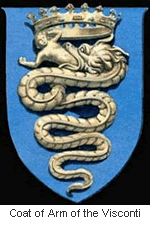
Alfa Romeo’s distinctive logo was created in 1910 by a draftsman named Romano Cattaneo. One day, while waiting for a tram at the Piazza Castello station in Milan, he was inspired by the red cross in the Milan Flag and the Coat of Arms of the noble House of Visconti, which featured a biscione (grass snake) with a man in its jaws, symbolizing "Visconti’s enemies that the snake [was] always ready to destroy." (Source) Two Savoia dynasty knots separated the words ALFA and MILANO.
The Romeo part came in 1916 when Neapolitan businessman Nicola Romeo bought the company and converted its factories to produce munitions and machineries for World War I. After the war, the company went back to producing cars and took on its owner’s last name to become Alfa Romeo.

Aston Martin
Evolution of Car Logos review and news icon
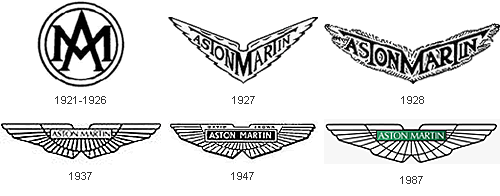
In 1913, Lionel Martin and Robert Bamford founded a company that later would become Aston Martin. At the time, Martin & Bamford Limited produced Singers racing cars, but the duo wanted to create a more sophisticated model of their own. They named their first car Aston Martin after the founder Lionel Martin and the Aston Clinton hill climb racing course where their Singers car had won previously.
We can’t talk about Aston Martin without mentioning James Bond. In 1959, Ian Fleming put his super spy James Bond in an Aston Martin DB Mark III. When it was made into a movie in 1964, Bond drove an updated, supersleek silver Aston Martin DB5 (complete with machine gun, passenger ejector seat, and revolving number plates!)
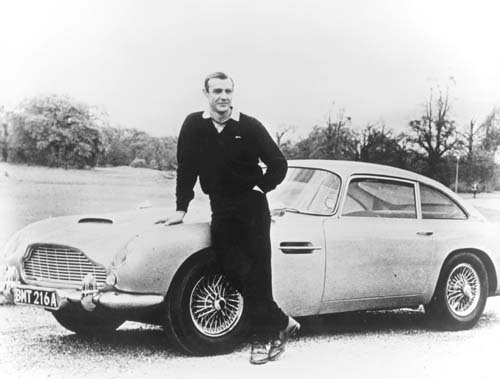
James Bond and his Aston Martin DB5 in Goldfinger
Interestingly, Ian Fleming himself didn’t drive Aston Martin. He preferred the 1963 Studebaker Avanti!

Audi
Evolution of Car Logos review and news icon
German engineer August Horch, who used to work for Karl Benz, founded his own automobile company A. Horch & Cie in 1899. A decade later, he was forced out of his own company and set up a new company in another town and continued using the Horch brand. His former partners sued him, and August Horch was forced to look for a new name.
When Horch was talking to his business partner Franz Fikentscher at Franz’s apartment, Franz’s son came up with the name Audi:
During this meeting Franz’s son was quietly studying Latin in a corner of the room. Several times he looked like he was on the verge of saying something but would just swallow his words and continue working, until he finally blurted out, "Father – audiatur et altera pars… wouldn’t it be a good idea to call it audi instead of horch?". "Horch!" in German means "Hark!" or "listen", which is "Audi" in Latin. The idea was enthusiastically accepted by everyone attending the meeting. (Source: Wikipedia, A History of Progress (1996) – Chronicle of the Audi AG)
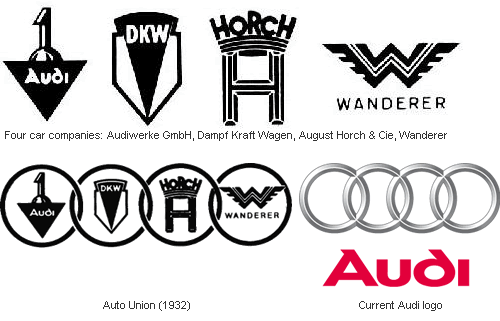
And so Audiwerke GmbH was born in 1910. In 1932, four car makers Audi, Horch, DKW, and Wanderer merged to form Auto Union. The logo of Auto Union, four interlinked rings that would later become the modern Audi logo, was used only in racing cars – the four factories continued to produce cars under their own names and emblems.
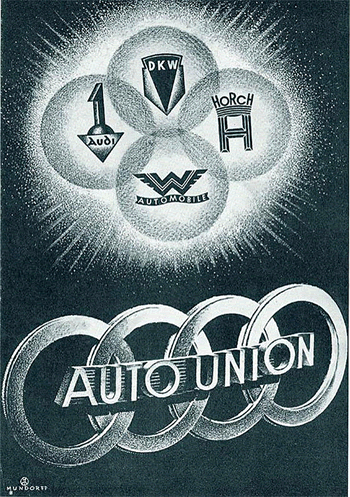
Four car companies became Auto Union (1932)
Fast forward to 1985 (skipping a whole lot of history), when Auto Union ultimately became the Audi we know today.

BMW


Source: Motorcycle
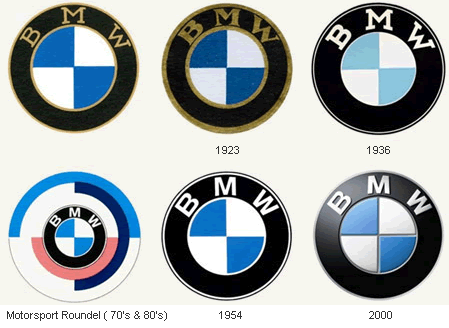
In 1913, Karl Friedrich Rapp and Gustav Otto founded two separate aircraft factories that would later merge to form BMW or Bayerische Motoren Werke AG (Bavarian Motor Works). Rapp and Otto actually had little to do with BMW’s manufacturing of cars. Josef Popp, Max Friz and Camillo Castiglioni were the ones who played big roles in making BMW a modern car manufacturer.
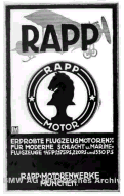
Source: Cartype
The circular BMW logo was a representation of a spinning propeller of a Bavarian Luftwaffe. At the time, aircrafts were painted with regional colors and the colors of the Bavarian flag were white and blue. It is said that the pilot saw the propeller as alternating segments of white and blue, hence the logo. The roundel was a nod to Karl Rapp’s original company.
During World War I, BMW was a major supplier of airplane engines
(and later airplanes such as the Red Baron)
(thanks Redditors!) to the German government. After the war, Germany was forbidden by the Treaty of Versailles to manufacture airplanes and BMW was forced to change its business: it first made railway brakes before making motorized bicycle, motorcycles and cars.
Update 3/6/08: Neatorama readers Dan S. and Bruce Kennedy who pointed out that the idea of BMW logo being derived from spinning propeller was actually an advertisement by the company (scroll down about halfway). Also thanks to klaus who pointed us out to the logo of EMW, which BMW took over in 1928.

Buick


Early Buick emblems (source: Buick Car Club of Australia)
The Buick Motor Company was founded in 1903 by David Dunbar Buick, a Scottish-American inventor who invented the overhead valve engine. If you didn’t recognize the name, you’re not alone – but remember this: Buick, a high school drop out founded a company that later became the world’s largest auto company, General Motors.
At 15 years of age, Buick dropped out of school to work for a plumbing fixture manufacturer. When that business failed, Buick and his friend took it over – but within a few years, Buick had an argument with his partner because he preferred to spend his time tinkering with car engines. Buick sold his share in the company and quit.
With the money, Buick founded the Buick Motor Company and within a few years ran it to the ground. He was kicked out of the company by his partner William "Billy" Durant in 1906 and later sold his stock for a mere $100,000. Had he held on to his shares, it would’ve been worth well over $100 million today. In his later years, Buick held low-paying jobs and couldn’t even afford a telephone. He died penniless as an inspector at the Detroit School of Trades. Ironically, years later Durant himself would be forced out. General Motors, the company that Durant built, refused him pension and he died almost penniless. (Source)

Buick crests and tri-shields (source: Buick Car Club of Australia)
Back to the logo story: Early Buick logos were variations of the cursive word "Buick." In 1930s, General Motor Styling researcher Ralph Pew found a description of the Scottish "Buik" [sic] family crest and decided to use it as a radiator grille decoration. In 1960, the logo incorporated three such shields, to represent the three Buick models then built: LeSabre, Invicta, and Electra.
In 1975, Buick changed their logo to a hawk named "Happy" with the launch of their Skyhawk line. However, in the late 1980s, as the Skyhawk car was retired, Buick went back to the tri-shield logo.

Cadillac


Source: car-nection.com, who has lots more Cadillac emblems.
When Henry Ford left his second automobile company, Henry Ford Company (see below), his financial backers tried to liquidate the company’s assets. An engineer named Henry M. Leland persuaded them to continue the company instead. They listened, and so Cadillac was born.
Cadillac’s first logo was based on a family crest of a minor aristocrat that the company was named after: Antoine de La Mothe, Seigneur de Cadillac (Sir of Cadillac). In 1701, de La Mothe founded Fort Pontchartrain which would later become Detroit. Cadillac was named after de La Mothe in 1902, following a bicentenary celebration of the founding of the city.
Problem was, de La Mothe was never a nobility! Born Antoine Laumet, de La Mothe was forced to leave France for America under a mysterious circumstance (some say he committed a crime or was unable to pay his debt). In the New World, he was able to assume a new identity and cobbled together a famiy crest with elements "borrowed" from, shall we say nobler sources.
In 1998, Cadillac had a new design philosophy called "art and science" and had its logo redesigned. Gone were the six birds called the merlettes, the crown, and the entire fabricated de La Mothe family crest as the company tried to shake up its stodgy image. The new logo made its debut a few years later, looking positively like it was made by Piet Mondrian!

Fiat


Source: Fiat
Fiat, then named Fabbrica Italiana Automobili Torino (Italian Automobile Factory of Turin), was founded in 1899 by a group of investors, including Giovanni Agnelli who later became its Managing Director. Agnelli bought his shares for $400 (about $10,000 in 2007 money). It’s worth billions now, and there had been an Agnelli in Fiat management ever since. Regardless or perhaps because of its wealth, the Agnelli clan remained a fractious and complicated group of people.
Supposedly, the famous Fiat "scrabble tiles" logo of the 1960s was designed by the company’s Chief Designer who was driving past the Fiat factory during a power outage and saw an outline of the factory’s neon sign against the dark sky (Source: The Language of Auto Emblems)

Ford
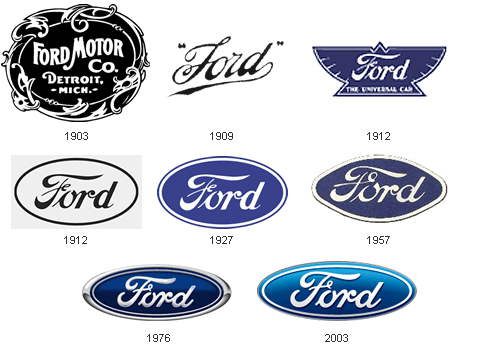

Most people know that Ford was founded by (who else?) Henry Ford. What most people didn’t know was that this was his third automobile company. Ford experimented with cars while working for Thomas Edison, and left to found his first auto company, The Detroit Automobile Company, which went bankrupt in just 2 years. He then built a race car and founded Henry Ford Company. Ford left that one after just one year (the company later became Cadillac – see above).
In 1902, Ford went on to create his third automobile company, the Ford & Malcomson, Ltd., and almost lost that one when sales were slow. He was unable to pay his bills to John and Horace Dodge, who supplied parts. Ford’s partner brought in a group of investors and even convinced the Dodge Brothers to accept shares in the company, which was renamed Ford Motor Company. Later, the Dodge Brothers went on to form their own car company (can you guess what?)
In 1909, Childe Harold Wills, Ford’s first chief engineer and designer (who also help to design the Model T), lend a script font that he created to make his own business card, to create the Ford logo. The famous blue oval was added later for the 1927 Model A – it remained in use until today.

Mazda


Source: Mazda [wikipedia] and Mazda Brand Evolution
Mazda began its life in 1920 as the Toyo Cork Kogyo Co. in Hiroshima, Japan. At the time, there was a cork shortage because of World War I, so the company was founded to process a cork substitute made from the bark of an Abemaki or Chinese cork oak tree. It was a good idea at the time, but shortly afterwards Japan could get real cork again and the company foundered.
In 1927, Jujiro Matsuda came onboard and the company began manufacturing tools, three-wheeled "trucks" and then cars. After World War II, the company formally adopted the name Mazda, which depending on who you ask, stood for the Zoroastrian god Ahura Mazda or an anglicized pronunciation of Matsuda the founder’s name (or both).
In the 1936 logo, the M shaped curve was inspired by the emblem of Hiroshima city. The 1991 and 1992 logos symbolized a wing, the Sun and a circle of light. Mazda’s current logo, nicknamed the "owl" logo, was designed by Rei Yoshimara in 1997. The stylized "M" was meant to look like stretched wings, but many people saw a stylized tulip instead.

Mercedes-Benz

The modern Mercedes-Benz traced its lineage to a 1926 merger of two car companies, Daimler-Motored-Gesellschaft or DMG, founded by Gottlieb Daimler (along with Wilhelm Maybach), and Benz & Cie, founded by Karl Benz. Both Daimler and Benz worked independently to invent internal combustion-powered automobiles. Their factories were actually just 60 miles apart, yet they didn’t know of each other’s early work.
After World War I, the German economy was in tatters, and to survive, the two companies formed a syndicate in 1924, where they would continue to sell their separate brands but would standardize design, share purchasing and advertising. In 1926, however, the two companies merged into Daimler-Benz.
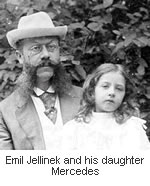
The name "Mercedes" came about in 1900. A wealthy European businessman and racing enthusiast named Emil Jellinek began selling Daimler’s cars. He wanted a faster car, and specified a new engine to be designed by Maybach and to be named after his 10-year-old daughter’s nickname, Mercédès or Spanish for
"grace."
"Mercy" (See below)
Jellinek was quite a character. He used to pepper DMG’s engineers with colorful suggestions and criticism such as "Your manure wagon has just broken down on schedule" and "You are all donkeys". However, as he actually sold a lot of cars, he was tolerated and even listened to. Later, Jellinek would add Mercedes to his own and became Emil Jellinek-Mercedes. (Source: My Father Mr. Mercedes by Guy Jellinek-Mercedes and MBUSA Biographies)
The star in Daimler’s logo came from an old postcard where Gottlieb Daimler had drawn a star above the picture of his house and wrote that "this star would one day shine over [his] own factory to symbolize prosperity." The three-pointed star symbolized Daimler’s ambition of making vehicles "on land, on water and in the air." (Source: Daimler)
After the merger, a new logo was designed. It combined the symbols of the two companies: the three-pointed star of DMG and the laurel wreath of Benz.
Update 2/18/08: There’s a dispute on the origin of the name “Mercedes.” According to Baby Names World, Mercedes is a girl’s name of Spanish origin meaning “Mercy.” It was taken from the Virgin Mary’s liturgical title “Maria de las Mercedes” (Mary of the Mercies; ‘Our Lady of Ransom’):

Latin ‘mercedes’ originally meant ‘wages’ or ‘ransom’.
In Christian theology, Christ’s sacrifice is regarded as a ‘ransom for the sins of mankind’, hence an ‘act of ransom’ was seen as identical with an ‘act of mercy’.

Mitsubishi

Source: Mitsubishi
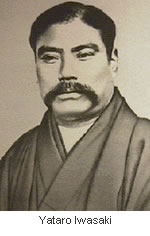
In 1854 feudal Japan, a man named Yataro Iwasaki, son of a provincial farmer whose grandfather sold the family’s samurai status to settle some debt, began his career on the wrong foot: he was called home from school at the age of 19 when his father was injured in a dispute with the village leader. Iwasaki asked a local magistrate to hear his case, and when refused, accused the man of corruption. Iwasaki was promptly jailed for seven months.
Fast forward to 1868: Iwasaki was working for the Tosa clan when the Meiji Restoration abolished Japan’s feudal clan system. He acquired Tsukumo Shokai, the Tosa clan’s shipping business and renamed it Mitsubishi in 1873.
It was a fourth-generation Iwasaki, a man named Kayota Iwasaki, who turned Mitsubishi into a giant corporate group that included an automobile manufacturing company, Mitsubishi Motors.
The name Mitsubishi was a combination of the words "mitsu" (three) and "hishi" (water chestnut, used in Japan to mean a rhombus or a diamond shape). The official translation of the name was "three diamonds."
The Mitsubishi logo was a combination of the Iwasaki family crest, three stacked diamonds, and the three-leaf crest of the Tosa Clan.

Peugeot

Peugeot got its start in 1812 in Montbeliard, France, when two brothers, Jean-Pierre and Jean-Frédéric Peugeot converted their windmill into a steel mill. Their first products were rolled steel for saw blades and clock springs, as well as cylindrical steel rods. For decades, the Peugeot family business made metal goods, machine tools, crinoline dresses, umbrellas, wire wheels, irons, sewing machines, kitchen gadgets and by 1885, bicycles.
Indeed, Peugeot’s entry into the automobile business was by way of bicycles. At the time, the company was one of the largest bicycle manufacturers in France. In 1889, Armand Peugeot created the company’s first steam-powered car. A year later, he abandoned steam in favor of gas-powered internal combustion engine after meeting Gottlieb Daimler.
The Peugeot "lion" logo was designed by jeweler and engraver Justin Blazer in 1847. It was based on the flag of the Région Franche-Comté. The logo was stamped on Peugeot kitchen gadgets to denote the quality of their steel. It took Armand 14 years to convince his family that cars could be a moneymaker. Only then did they allow him to use the Peugeot lion logo. (Source: Independent)
Now, you may not drive a Peugeot car, but I bet you’ve used a Peugeot invention of 1842: the peppermill. The mill’smechanism was so reliable that it remained virtually unchanged until today.

Renault


Source: Renault
Louis Renault was 21 when he made his first car in the backyard of his parent’s home. He soon got orders for cars, so in 1898, along with his brothers and friends, Louis opened the company Société Renault Frères in Boulogne-Billancourt, France.
The first Renault logo, drawn in 1900 featured the three initials of the Renault brothers: Louis, Ferdinand and Marcel. In 1906, the logo changed to a front end of a car enclosed in a gear wheel.
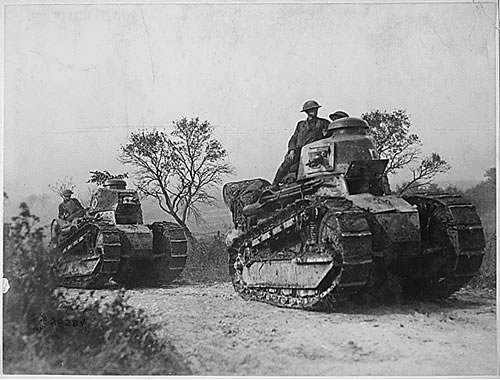
Renault FT-17 tank, driven by American troops, going forward to the battle line in the Forest of Argonne. (Source: The National Archives)
During World War I, Renault manufactured light tanks for the Allies called the Renault FT-17. This was so popular that after the war, Renault actually changed its logo into a tank. The diamond shape was introduced in 1925 and remained until today. The modern Renault logo was created in 1972 by Victor Vasarely [offical website | wikipedia], the father of Op art (or optical art).

Saab

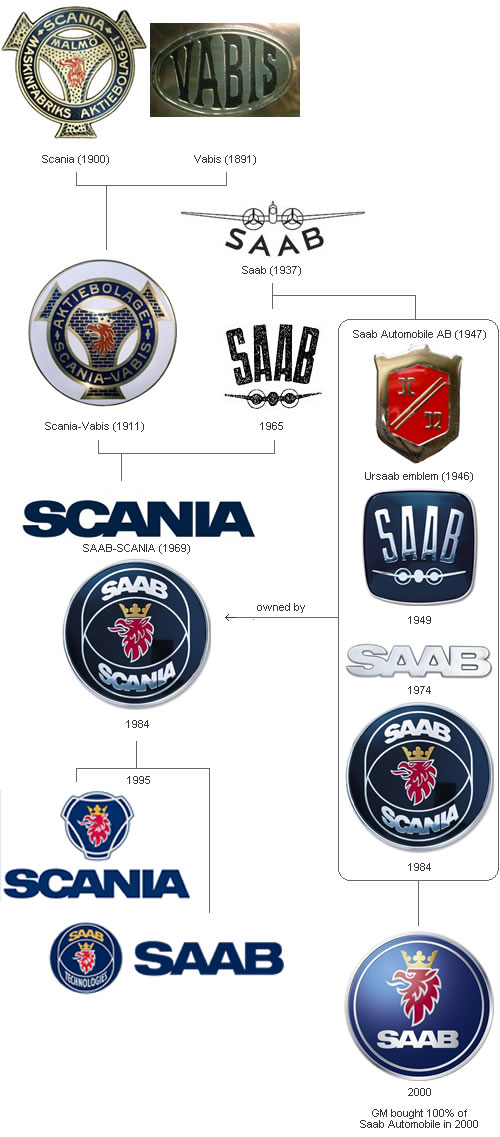
If you’ve ever seen a Saab car commercial, then you’d know that the company was "born from jets". You wouldn’t know it from the car’s staid style, but historically this was accurate: In 1937, an aircraft company called Svenska Aeroplan Aktiebolaget ("Swedish Aeroplane Limited" or simply SAAB) was created to meet the needs of the Swedish Air Force.
When World War II ended, SAAB the airplane company started making cars to diversify its business. The first car it made was a prototype called the the Saab 92001 or ursaab (meaning "original Saab") in 1946. It was test-driven for nearly 330,000 miles (530,000 km) in utter secrecy, usually on narrow and muddy forest roads in the early mornings or late nights.
In 1947, the Saab Automobile company was incorporated. The company’s first car was the Saab 92, named because it was simply the company’s 92nd design project (the previous 91 had all been aircraft).
The griffen logo, featuring the head of a mythological beast that had a body of a lion and head and wings of an eagle, came from Vadis-Scania, a truck manufacturer that merged with SAAB (airplane) company. The griffen was a coat of arms of the province Scania.
In 2000, Saab Automobile company was bought out by General Motors, and thus no longer had any connection with SAAB outside of its history and logo similarities.
Confused? Don’t worry about it, just enjoy the pictures.

Volkswagen


Source: TheSamba
You wouldn’t know it from the company’s website but Volkswagen (German for "People’s Car") can trace its history straight to the villain of World War II: Adolf Hitler.
Here’s the short version of the story: After World War I, Germany’s economy was shot and cars cost more than most people can afford. When Hitler rose to power and became Chancellor, he spoke at the 1933 Berlin Auto Show of his idea to create a new and affordable car.
At the same time, Ferdinand Porsche (yes, that Porsche) was designing an odd-looking yet inexpensive car (which would later become the Volkswagen Beetle). Porsche met with Hitler in 1934, who asked that the car to have the following specifications: it should have a top speed of 100 km/h (62 mph), a fuel consumption of 42 mpg, and could carry 2 adults and 3 children. He said the car should look like a Maikaefer – a May beetle and even gave Porsche a sketch of the basic design. Porsche promised to deliver the design, with prototype cars to be built by Daimler-Benz.
In 1937, the Gesellschaft zur Vorbereitung des Deutschen Volkswagens mbH was created (it became simply Volkswagenwerk GmbH a year later). In 1938, Hitler opened the state-funded Volkswagen factory in Wolfsburg, which was to produce the KdF-wagen (kraft durch freude, meaning "strength through joy"). Few were actually built, instead, the factory (employing forced labor) churned out military car, based on the same chassis: the Kübelwagen, Schwimmwagen, and Kommandeurwagen.
It was later found out that Hitler had this in mind all along. He added an extra secret specification to Porsche’s design: the car was to be able to carry 3 men, a machine gun, and ammunition.
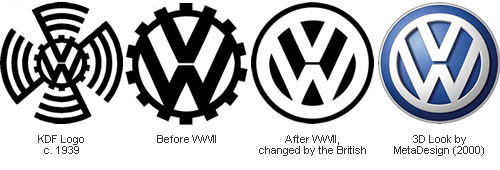
After Germany was defeated in World War II, the British took over the Volkswagen factory and the KdF-Wagen was renamed the Beetle. The British then sought to give control of the company – first they asked the Ford Motor Company, then the French Government, other British car manufacturers and lastly, Fiat. All turned down this "free offer" because they thought the Beetle’s design was inferior and that the company would be a money drain. (Source: The Auto Channel)
So, the British gave the Volkswagen company back to the German government in a trust. Later, having sold more than 21 million cars, the Volkswagen Beetle would become one of the world’s best selling cars ever.
The VW logo itself was supposedly designed by Franz Xavier Reimspiess, an employee of Porsche, during an office logo design competition. He was given a one time payment of 100 Reichsmarks (about $400).

If you didn’t see your favorite car’s logo history, chances are it is because its logo didn’t change much over the years. There are also dozens of large car companies in the world (many more if you counted the defunct ones), and we couldn’t fit every single one in this article. If I missed anything, please let me know in the comment.
by neatorama.com