For this concept, Lexus designers studied characteristics that are often considered contradictory and difficult to execute together,” said Kengo Matsumoto, general manager, Lexus Design Division, Toyota Motor Corporation. “The captivating design of the LF-Gh concept examines the possibility of balancing what are normally opposing qualities, such as style and functionality.”
The Lexus LF-Gh concept takes the company’s L-Finesse design philosophy one step forward and combines style, performance, efficiency, and environmental compatibility with advanced, new technologies. And, as with many other new concepts, the LF-Gh is also a hybrid vehicle.
Just when you thought Toyota had gotten over their 2010 recall catastrophe, their sister brand, Lexus, is starting the year of by catching the proverbial ‘bug’.There really is no rest for the weary, is there.?The Japanese automaker is issuing a voluntary safety recall involving 245,000 vehicles of the GS and IS models over what appears to be a potential defect that could cause fuel leakage.
According to Lexus, the problem is caused by a problem with the connection between the vehicle’s fuel pressure sensor and a fuel line that could loosen over time. This, in turn, could lead to a possible fuel leak.
Showing posts with label Lexus. Show all posts
Cadillac Ciel Concept
The Cadillac Ciel Concept - pronounced "C-L," the French translation for sky - is a four-seat convertible that opens a new chapter in Cadillac's design and product ascent, pushing the brand's Art & Science philosophy into a new stratum. Ciel is a new expression of Cadillac's historical grandeur, as well as a celebration of open-air motoring.
"Large, expressive luxury is innate to Cadillac and the Ciel recalls that heritage, while suggesting where the brand can go in the future," said Clay Dean, global design director for Cadillac. "Authentic luxury is driven by experiences, not just products, and Ciel is about the experience of the journey."
The spacious and elegant Cadillac Ciel Concept is a grand gesture that explores themes driving Cadillac's explorations into range-topping flagship luxury. It is powered by a twin-turbocharged version of the 3.6-liter Direct Injection V-6 engine, paired with a hybrid system using lithium-ion battery technology.
Coastal inspiration
Driving California's Highway 1 in an open car while the sun sets, from Big Sur north to Monterey, is the type of journey the Ciel team envisioned during its design.
"The Ciel is about the romance of the drive," said Dean. "It emulates the great touring cars seen on the greens at Pebble Beach, but with a modern flair that projects Cadillac's vision for the future."
The four-door Cadillac Ciel Concept embraces the social aspects of a recreational journey, with generous room for two couples. It evokes the spirit of the classics with a long, low proportion. The doors are French-style, with the rear doors hinged at the rear - there is no B-pillar - to reveal a sweeping view of the dramatic interior. Distinguishing fender lines run from nose to tail, and nickel-plated bright work accents the body lines, enhancing the visual length of the car and honoring Cadillac touring cars of the past.
Use Powerful Forklift Parts In Your Truck
by: John Anthony
Forklifts are powered industrial trucks used in a number of industrial and warehousing applications. Forklifts are used in lifting and transporting huge loads and cargo. Important forklift truck accessories include rotators, roll clamps and carton clamps as standard attachments. Rotators help in handling skids and other speciality materials. Roll clamps are of two types: mechanical or hydraulic. These forklift truck attachments are used for handling barrels or paper rolls.
Today forklift truck attachments are available separately to meet the varying needs of a single user. The user can use these forklift truck accessories on a standard forklift by simply attaching the desired attachment on it. Forktruck attachments are available for lifting heavy loads and moving them in areas that are difficult to reach. Quick-tach truss boom is one such attachment that yields greater manoeuvrability during construction works. Hoppers and self dump buckets are used in cleaning the debris and unwanted materials from work sites. Carton clamps are another type of attachments that enable the lift operator to open and close the clamp around the load allowing it to pick it up smoothly.
Forklifts are hazardous machines, so they should be handled with care. Finding the right forklift truck accessories is therefore important. Before attaching any forklift truck attachments on the equipment, you should ensure that they meet the OSHA guidelines and are matching the specifications of the forklifts in use. It is dangerous to overload the forklifts. The allowable weight is labelled on every machine, so it is advised that you strictly follow those instructions. Overloading will result in skidding and overturning. This may bring huge damage to people and property, so care should be taken to avoid such mishaps. By using the best quality forklift truck accessories you can avoid accidents.
Selecting the right accessories and forklift truck attachments helps you save hugely on the cost of operation. If you are equipped with the right forklift, you can get the work done in an efficient manner. Forklifts are available in a variety of sizes and specifications. If you are buying forklift truck accessories, you must ensure that they suit the machine and are able to carry out the work effectively. Never overestimate the power of forklift parts and its accessories. All parts and accessories of the forklifts have to be maintained regularly so that they perform efficiently ensuring safety and satisfaction to workers.
If you are planning to buy or hire a forklift truck, go for good quality trucks from famous brands like Linde Material Handling, Raymond, Toyota, Mitsubishi, Hyster and Atlet. They are the leading manufacturers of http://www.tradepub.com/free-offer/global-finance/gf?sr=hicat&_t=hicat:1057 forklift trucks, so you can rely on their products confidently. Identify the authorised dealers of these companies and get the best quality product that suits your budget. If your budget is low, you may opt for used forklifts and fork truck attachments which are also available as fully functional. You may procure these attachments from the same dealers who also deal with sale/purchase of old forklifts and accessories. Buying a used forklift will be a great deal for those who cannot afford for new ones.
2013 Lexus GS 350
Lexus will announce the concept of the 2013 Lexus GS 350 at Pebble Beach Concours d’Elegance on August 18. Luxury sedan teaser images have revealed a front-end design of all-new model. Image manipulated to bring out the fine grill lines, and intricate details of the design of the bumper and hood.
2013 Lexus GS 350 will feature a brand new design philosophy, with a hint of new styles like the distinctive front grille, which will soon be seen on all future Lexus vehicles. The new GS will also lead the rest of the Lexus lineup in an entirely new direction of the driving dynamics. Possible 2013 Lexus GS 350 will be powered by a 3.5-liter V6 is well known.
“Today, buyers in mid-size luxury segment want a more exciting driving experience, a style that makes statements, and a roomier interior package,” said Mark Templin, Lexus group vice president and general manager.
“With all the new GS, we are giving them what they asked for, and much more.” She finished.
Citroën DS3 R3
In addition to Citroën Racing's official participation in WRC, where it has won five FIA World Championship Constructors' titles, Citroën Racing has always offered products designed for customers. The champion team has now furthered this rich tradition with Citroën DS3 R3, a model set to make its rallying debut at the end of 2010. Versatile, high performance and yet affordably-priced, Citroën DS3 R3 is set to become the new leader in its category.
Based on the FIA's new Group R3T regulations, Citroën DS3 R3 features the same structural design and appearance as the production model, with the production steel body shell reinforced by a welded, multi-point roll cage, improving the resilience of the chassis and safety for the driver pairing.
Under the bonnet lies a four-cylinder 1.6-litre THP (high pressure turbo) engine, which has been developed using the PSA production engine. Specific racing parts (air box, camshaft, pistons, connecting rods, exhaust and turbo systems, electronic unit, etc.) have been deployed to boost the car's power to 210bhp. In addition to its overall power, special attention has been given to increasing the engine's torque to improve traction, one of the key factors in delivering efficient driving performance. With 350Nm, the Citroën DS3 R3 engine offers unrivalled flexibility on the road.
Citroën DS3 R3 has benefitted from the extensive expertise acquired by Citroën Racing through its involvement in the World Rally Championship. As with the C4 WRC, the six-speed gearbox features semi-automatic sequential control, enabling gear changes to be made twice as quickly as with a manual gearbox, whilst also improving the reliability of the car's powertrain.
Land Rover Range Rover Black
"The Land Rover Range Rover Autobiography Black represents the very best Range Rover has to offer and is a fitting tribute to a vehicle which has consistently set the highest standards for all-terrain performance, luxury and design for the last 40 years." Phil Popham, Land Rover Managing Director
The ultimate incarnation of the Range Rover, the Land Rover Range Rover Autobiography Black 40th Anniversary Limited Edition, is quite simply the last word in bespoke vehicles.
With a unique finish in Barolo Black, the exterior also features 20-inch alloy wheels, Diamond Turned, a unique front grille with Titan grille mesh, a bright chrome grille 'U' edge and black grille surround. Side vents have a new mesh set off by bright chrome bars and a black vent surround. There are body coloured door handles and of course, the tailgate badge, 'Autobiography Black'.
Inside, there's a choice of the standard colourway in Jet, or two colourways unique to the Land Rover Range Rover Autobiography Black - Jet and Ivory, or Jet and Pimento. The Autobiography Black logo is discretely repeated throughout the interior where it is embossed on the rear seat armrest and appears on the four unique, Grand Black door veneers. Front door sill tread plates are illuminated with the words 'Range Rover' and there's a half wood Grand Black steering wheel. Petrol models also offer gearknob veneers.
"At the top of the Range, the new Land Rover Range Rover Autobiography Black 40th Anniversary Limited Edition offers customers the option of complete exclusivity with unique colourway combinations as well as striking interior and exterior design features. Around 700 will be made, emphasising the exclusivity of this limited edition." Design Director, Gerry McGovern
No detail has been overlooked in ensuring this is the most special Range Rover in the marque's 40 year history. Even the key fob and driver's handbook carry the Autobiography Black logo.
Land Rover Freelander 2
The 2011 Land Rover Freelander 2 model range, on sale in the UK from the end of September 2010, benefits from a new 2.2-litre diesel engine available with either 150PS or 190PS outputs, a new look exterior plus interior alterations including new instrument dials and a new Premium Pack option.
Land Rover's new turbo diesel engine is available in the 4WD TD4 150PS model featuring a manual transmission and intelligent Stop/Start technology as standard (an automatic gearbox without Stop/Start is available as a cost option), or the new SD4 model delivering 190PS (available in automatic transmission only).
This new engine is quieter, more efficient and both derivatives have 20Nm more torque than the outgoing engine. This means the 2011 Freelander 2 offers improved engine response and more mid-range strength for towing. CO2 emissions have been significantly reduced to 165g/km and 185g/km respectively with corresponding fuel economy benefits.
However, despite reductions in consumption and emissions, there has been no compromise in performance. The flagship 190PS Land Rover Freelander SD4 accelerates from rest to 60mph in 8.7 seconds with an increased top speed of 118mph. The Land Rover Freelander 150PS TD4 manual and automatic versions match the performance of their predecessors.
As well as being upgraded from EU4 to EU5, both versions have a new variable geometry turbocharger and have been extensively re-calibrated to deliver new levels of power, meet emissions regulations and reduce CO2 emissions. They are fitted with a catalysed diesel particulate filter as standard and are now compatible with 10 per cent biodiesel rather than 5 per cent.
As an addition to the Land Rover Freelander 2 range, Land Rover will also offer customers a 2WD derivative, available in the UK from January 2011. This will be called the Land Rover Freelander 2 eD4 and it will be the most efficient Land Rover ever produced, with fuel consumption of 47.2mpg combined, and CO2 emissions of just 158g/km.
"The new Land Rover Freelander 2 eD4 moves Land Rover into the hugely popular and fiercely contested two wheel-drive SUV market," said Land Rover managing director Phil Popham. "The European market for two-wheel drive SUVs represents 23 percent of the segment and we intend to compete strongly here.
"A 2WD option is just one way in which we are developing our vehicles' efficiency whilst adding to the Land Rover range and expanding our appeal to a broader group of customers. We will continue to make the 'world's finest all-terrain vehicles' for those customers who require 4WD but will also now offer an alternative."
This groundbreaking Land Rover Freelander 2 eD4 is powered by the new 2.2-litre turbo diesel engine, delivering 150PS. It is only available with a six-speed manual transmission featuring Stop/Start technology as standard.
The exterior of the latest Land Rover Freelander 2 gets a new look for 2011. Marked out by a new front bumper assembly incorporating new front fog lap bezels, a new front grille finish, improved headlights and tail lamps, new full width tailgate appliqué and new 18- or 19-inch alloy wheel styles. There are three new colour schemes for 2011 Kosrae Green, Baltic Blue and Fuji White.
Inside the cabin, Land Rover's design team have revised the instrument dials, and there are four new seat styles with the option of a Premium Pack that includes Windsor Leather upholstery, an 8/6 way electric seat, plus premium carpet mats and covered centre stowage.
2011 Lexus LS 460 with 380 hp
Lexus has constantly been a great environmentalist products, specifically because the green issues was first commence.Well, if case you’ve ever interested in ever purchasing one, the new Lexus is to be more economical than other brands within the same line of cars.19-inch forged wheels The sole powertrain is made up of a 4.6 liter The engine is rated at 380 horsepower at 6,400 rpm along with 367 lb-ft of torque at 4,100 rpm in 2WD form, and it drops to 357 horsepower and 344 lb.-ft. of torque with all-wheel drive.It returns 16 mpg in the city cycle and 24 mpg on the highway in 2WD form, and retains 16 mpg in the city with a single digit drop to 23 mpg highway in AWD form. The engine is one of few V8s that qualify the LS as a ULEV 2 vehicle. Anti-lock brakes, electronic brake force distribution, brake assist and 10 airbags are of course standard. The power steering is electrical and high-intensity discharge headlights with dynamic auto leveling are included.
The Lexus eight speed automatic transmission enable gear ratios that increase to the greatest amount or degree torque up to the tire grip limitations in the lower ranges yet preserve quietness and marvelous fuel efficiency at higher speeds.
Tags:2011 Lexus LS 460 for sale,2011 Lexus LS 460 parts,2011 Lexus LS 460 overview,2011 Lexus LS 460 highspeed,2011 Lexus LS 460 colors,2011 Lexus LS 460 prices,2011 Lexus LS 460 mileage,2011 Lexus LS 460 user's view,2011 Lexus LS 460 interior details, 2011 Lexus LS 460 exterior details,2011 Lexus LS 460 engine,2011 Lexus LS 460 in india,used 2011 Lexus LS 460,2011 Lexus LS 460 fuel consumption
Gazoo Racing Lexus CT 200h Nurburgring Racer
Tomorrow (14 May) Lexus hybrid hatchback will take on the Nurburgring endurance race to make the presence of company’s hybrid racers known.
The GAZOO Racing CT as it’s known is powered by the same Lexus Hybrid Drive as the road car but with a higher capacity 2.4-litre petrol engine instead of the usual 1.8 unit. At start-up and under braking, the race car uses just its electric motor, producing zero tailpipe emissions and using no fuel. The sophisticated system is also capable of intelligently selects the most appropriate power source and also captures energy through regenerative braking to charge the battery, which in turn powers the electric motor.
It may not be just as fast as other cars in this category, but it uses much less fuel which
means it can stay out on the track and do more laps. As you know in endurance racing it’s the number of laps you do that counts.The GAZOO Racing CT driver line-up features three experienced pilots: Kumi Sato, a female racer who competed in a Lexus IS 250 in 2008; Masahiko Kageyama, who previously supported Toyota’s vehicle development programme; and MinoruTakaki, who is responsible for production vehicle development. The CT is competing in the Adenauer ADAC Rundstrecken-Trophy, contested over six hours.
2011 Lexus IS 250C and IS 350C: Car Seat Check
The 2011 Lexus IS 250C is the hardtop convertible version of the IS 250, a sporty sedan. While the IS sedan can hold five passengers, the IS 250C carries four. There’s also a significant difference in rear legroom between the two models. The sedan has 30.6 inches of legroom in the second row; the convertible has only 25.9 inches, which made it difficult to install rear-facing child-safety seats in it. Our results can also be applied to the 2011 Lexus IS 350C, which offers a more powerful V-6 engine than its 250C sibling.
For the Car Seat Check, we use a Graco SnugRide 30 rear-facing infant-safety seat, a Britax Roundabout convertible child-safety seat and Graco high-back TurboBooster seat. The front seats are adjusted to a comfortable position for a 6-foot driver and a 5-foot-8 passenger. The three child seats are installed in the second row. The booster seat sits behind the driver’s seat, and the infant seat and convertible seats are installed behind the passenger seat. We also install the infant seat in the second row’s middle seat with the booster and convertible in the outboard seats to see if three car seats will fit. If there’s a third row, we install the booster seat and a forward-facing convertible.
Here’s how the 2011 IS 250C and IS 350C did in MotherProof.com’s Car Seat Check:
Latch system: There are two sets of lower Latch anchors in the convertible’s two-person backseat. The anchors are deeply buried in the seat bight, where the back and bottom cushions meet. The seats have significant seat bolsters and the anchors are set close together, making it difficult to install a car seat.
Two tether anchors sit under hinged covers at the base of the roll bars. The covers make it difficult to use the anchors. We had to flop the head restraints forward to get at the anchors.

Booster seat: The seat bolsters helped give our high-back booster seat a good fit in the convertible. However, the limited legroom in the second row will create problems for a child sitting in the seat. The seat belt buckles are well-anchored and sit high enough that kids in boosters can easily use them.


Convertible seat: To get the rear-facing convertible to fit in the IS 250C, we had to move the front passenger seat all the way forward. This left no room for the front passenger. We also had fit problems with the forward-facing convertible. The rear seatback has little to no recline, which pushed the convertible far forward. At least half of the convertible’s base was off of the bottom seat cushion. This shows yet again that not every car seat fits in every car.

Infant-safety seat: We also had to move the front passenger seat all the way forward to get this rear-facing car seat to fit in the convertible. As with the rear-facing convertible, there wasn’t enough room for the front passenger.

How many car seats fit? 2, but they’ll need to be forward-facing
Editor’s note: For three car seats—infant-safety seat, convertible and booster seats—to fit in a car, our criteria is that a child sitting in the booster seat must be able to reach the seat belt buckle. Parents should also remember that they can use the Latch system or a seat belt to install a car seat.
by motherproof.com
2011 Lexus IS F – Short Take Road Test

In revising the IS F’s suspension, Lexus reinvents its sport sedan.
The corporate line at Lexus is that the IS F was never intended to dethrone the BMW M3 as the world’s greatest sports sedan. We, like the general public, never believed it. Just look at the two cars’ spec sheets: Both are based on their respective company’s entry-level sedan; both have special, 400-plus-hp V-8s shoehorned up front; and both have big brakes, ultra-high-performance tires, upgraded sport seats, and so on.
by /blog.caranddriver.com
2011 Lexus IS250 F Sport Review & Test Drive

One of the more exciting aspects of Toyota can be found in their Lexus line of vehicles starting with the new 2011 Lexus IS250. The new Lexus IS has been a very successful sports sedan keeping its aggressive finesse while receiving a minor face-lift for 2011.
My new Ultrasonic Blue 2011 Lexus IS250 was optioned with a new F-Sport package that incorporates a firmer suspension upgrade, heated sports seats with microfiber inserts, 18-inch dark-finished wheels, grill inserts and an F-Sport badge on the side of the front fender. One quick look and this Lexus IS250 F Sport package closely resembles the top-of-the-line performance oriented ISF. Although the lackluster 2.5-liter V6 producing only 204 horsepower and 185 pound-feet of torque refracts any bit of real ‘sport’ from the IS250, it still comes off as a capable performer visually and in the turns.

Despite the Lexus IS250 being in need of much more power, the ride is firm and stable at high speeds. It is almost deceiving because the vehicle feels as if it should have much more power. This is mostly due to the F Sport package which meshes better with the IS350’s 3.5-liter V6 with 306 horsepower. Luckily, the IS250’s V6 engine is as smooth as silk but does have a bit of weight, 3,455 lbs to lug around. Normal driving is never a problem as the small V6 does not seem to strain much with its well-managed and soft-shifting 6sp automatic transmission.

The larger 18-inch wheels with 255-series tires on the rear aided in the IS250’s handling abilities. In other words, the IS250 would have no problem handling 100 more horses just as it is with the F Sport package. Not to mention, they look great with the Ultra Sonic Blue paint job commonly found on the monstrous 417 horsepower Lexus ISF.

The interior is a bit cramped for someone just over 6 feet tall though, it’s manageable. At times I would hit my head on the roof but it is nothing a simple adjustment of the 8-way power sport seats can’t fix. Fit and finish of Lexus interiors are always top-notch as it is in the new 2011 Lexus IS250. Just about every aspect of the Lexus IS250’s interior screams high-quality. The same can be said about the build quality of the new IS having a quiet cabin that is never disturbed with odd sounds or rattles. The Lexus IS’s interior gives its German competition – the BMW 3 Series, Benz C-Class and Audi A4 – a serious run for the money.
The new gauge cluster in the IS250 is somewhat of an evolution from the chronograph styled gauges in the outgoing IS300 from the early 2000’s. The dials are big, bright and easy to read in a nice white-light, which is very Lexus-Esq. The adjustable speed limiting orange LED light ring is a nice touch also warning you that you have passed a manually pre-set speed limit.

In the rear things get even more cramped in the new IS250 with only 30.6 inches of rear leg room, 4 inches less than the current BMW 3 Series sedan. A rear pass-through is only offered for the extra cargo storage instead of folding rear seats. Fortunately, trunk space is at 13 cubic feet which is about the normal capacity for this class of vehicle.
Making up for the small seating areas would be the Lexus IS250’s comfortable ride and ease of drivability. The power steering is somewhat predictable. The variable power assist does not communicate the road to the driver as you would expect from a car that looks this sporty. The steering, however, does a good job of firming during highway speeds versus parking maneuvers.

Sales figures of the new Lexus IS would possibly prove it is appealing more for its sporty good-looks overlooking its lack of horsepower. I can say driving the new Lexus IS250 is a pleasure and more of a practical choice considering the more powerful IS350 starts at almost $7,000 more than the IS250. Gas figures for the IS250 are not much different than many other cars with a lot more power. I was able to get a decent 25 mpg in the city and near 31 mpg on the highway, just as the EPA estimates. Mpg figures for the IS250 are 24 mpg city and 30 mpg highway.
Automotive enthusiasts will find a lot of sex-appeal from the new Lexus IS250 with the F Sport package but walk way slightly disappointed with its lack of power and at the same time well-pleased with its nimble handling. At $36,630 for my IS250 F Sport package tester, Lexus remains to stay within reason for a manufacturer that has proven quality and almost unmatched fit and finish. Comparable configurations from BMW would cost $3,000 more but will also provide better performance.
by automotiveaddicts.com
Lexus LF-Gh Hybrid Concept at the 2011 New York Auto Show
- Looks like: Lexus is going for dark and sinister for its next sedan
- Defining characteristics: A yet unspecified hybrid powertrain
- Ridiculous features: Are side-view cameras ever going to take off? Not likely.
- Chances of being mass-produced: This is the next-generation GS; design language will come to all models
The LF-Gh stays pretty much true to form and function as the 2011 GS 450h. What doesn’t stay the same is the styling. Gone are the somewhat frumpy looks of the GS, replaced with creases and curves that exude poise and aggression. Lexus seems to have focused most of its attention on the front end: The concept features a new grille and headlamp designs that Lexus’ whole lineup will end up wearing over time, the automaker says.
Overall, the side silhouette is fairly uneventful — you’d have difficulty distinguishing it from the Infiniti M. The door handles and side mirrors have been “minimized,” Lexus, says, and we don’t believe either adaptation will make it to a production vehicle.
While there are only a few discrete photos of the interior, from what we can surmise the inside is near production ready. The dash and door inlays are adorned with cut-and-sewn leather. There’s a new analog clock with a “three-dimensional” face, according to Lexus. A depression near the driver’s center cluster likely houses the navigation system, similar to the design in the current RX.
The dimensions given for the concept and its rear-wheel-drive layout make us believe it’s the next-generation Lexus GS, though it could replace the GS and the ES in a bid by Lexus to be taken more seriously as a performance luxury division. The luxury make didn’t reveal any specs about the hybrid powertrain but says it’s a “Lexus Hybrid Drive.” Every Lexus hybrid currently features a different powertrain and power rating, so it’s hard to speculate on what hybrid system a production LF-Gh would get if not something entirely new.
We’ll have more comments and photos once the 2011 New York International Auto Show gets under way this month.


Ad Watch: Lexus LFA Breaks Champagne Glass Without Moving Review and news
In Lexus' latest advertisement for the already sold-out LFA, the 552-horse exotic remains stationary. It's strapped to a dyno, next to a champagne flute. As it races towards redline, the 4.8-liter V-10's exhaust note, channeled through a microphone and speaker, shatters the glass.
The ad, called "Pitch," began airing this month. In part, it aims to show the efforts taken by Lexus' to make the LFA's unmistakable exhaust note. Lexus says, in a press release, "After studying the unmistakable soundtrack generated by Formula 1 cars at maximum revs, the team created the signature LFA sound beginning by emphasizing the secondary combustion frequency of the engine and then introducing primary, secondary and tertiary firing harmonics."
Lexus claims to have used no camera tricks or computer-generated imagery in the ad. Instead, the team sourced a flute that would shatter at the frequency emitted by engine at redline. Click here to watch the ad. Click here to download audio clips of the LFA (under "Digital Premium").
Source: Lexus
Evolution of Car Logos review and news icon
Acura,
Audi,
BMW,
Cadillac,
Chevrolet,
Chrysler,
Ferrari,
Ford,
History,
Honda,
hyundai,
Lamborghini,
Lexus,
Mazda,
Motorcycle,
porsche,
toyota,
volvo
7:00 AM
Evolution of Car Logos review and news iconreview and news icon
his article should come in handy for the next time you’re stuck in traffic: have you ever wondered why the Audi in front of you has a logo of four interlocked rings? Did you know that the Cadillac emblem was inspired by a family crest of a nobleman who later turned out to be a fraud? Or that Volkswagen was Hitler’s idea?
We took a look at the evolution of tech logos before. Today, let’s take a look at the fascinating stories behind the logos of some of the most popular cars in the world:
Alfa Romeo
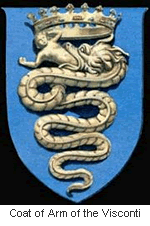
Surprise! Alfa Romeo, the car manufacturer and pride of Italy, traced its beginnings to France. In 1910, Milan aristocrat Cavaliere Ugo Stella collaborated with the French car company Darracq to market the line in Italy. When the partnership failed, Stella moved the company and renamed it Anonima Lombarda Fabbrica Automobili (Lombard Automobile Factory, Public Company) or A.L.F.A.Alfa Romeo’s distinctive logo was created in 1910 by a draftsman named Romano Cattaneo. One day, while waiting for a tram at the Piazza Castello station in Milan, he was inspired by the red cross in the Milan Flag and the Coat of Arms of the noble House of Visconti, which featured a biscione (grass snake) with a man in its jaws, symbolizing "Visconti’s enemies that the snake [was] always ready to destroy." (Source) Two Savoia dynasty knots separated the words ALFA and MILANO.
The Romeo part came in 1916 when Neapolitan businessman Nicola Romeo bought the company and converted its factories to produce munitions and machineries for World War I. After the war, the company went back to producing cars and took on its owner’s last name to become Alfa Romeo.
Aston Martin
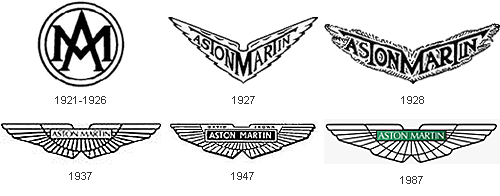
Evolution of Car Logos review and news iconIn 1913, Lionel Martin and Robert Bamford founded a company that later would become Aston Martin. At the time, Martin & Bamford Limited produced Singers racing cars, but the duo wanted to create a more sophisticated model of their own. They named their first car Aston Martin after the founder Lionel Martin and the Aston Clinton hill climb racing course where their Singers car had won previously.
We can’t talk about Aston Martin without mentioning James Bond. In 1959, Ian Fleming put his super spy James Bond in an Aston Martin DB Mark III. When it was made into a movie in 1964, Bond drove an updated, supersleek silver Aston Martin DB5 (complete with machine gun, passenger ejector seat, and revolving number plates!)
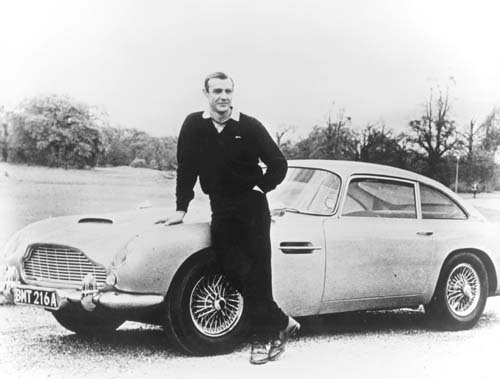
Interestingly, Ian Fleming himself didn’t drive Aston Martin. He preferred the 1963 Studebaker Avanti!
Audi
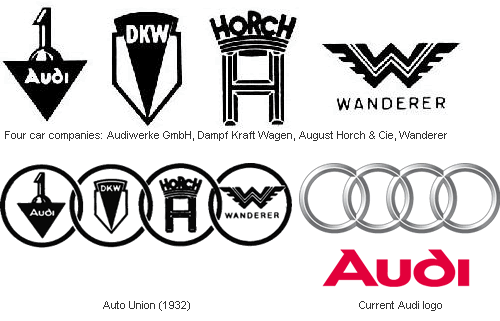
Evolution of Car Logos review and news iconGerman engineer August Horch, who used to work for Karl Benz, founded his own automobile company A. Horch & Cie in 1899. A decade later, he was forced out of his own company and set up a new company in another town and continued using the Horch brand. His former partners sued him, and August Horch was forced to look for a new name.
When Horch was talking to his business partner Franz Fikentscher at Franz’s apartment, Franz’s son came up with the name Audi:
During this meeting Franz’s son was quietly studying Latin in a corner of the room. Several times he looked like he was on the verge of saying something but would just swallow his words and continue working, until he finally blurted out, "Father – audiatur et altera pars… wouldn’t it be a good idea to call it audi instead of horch?". "Horch!" in German means "Hark!" or "listen", which is "Audi" in Latin. The idea was enthusiastically accepted by everyone attending the meeting. (Source: Wikipedia, A History of Progress (1996) – Chronicle of the Audi AG)And so Audiwerke GmbH was born in 1910. In 1932, four car makers Audi, Horch, DKW, and Wanderer merged to form Auto Union. The logo of Auto Union, four interlinked rings that would later become the modern Audi logo, was used only in racing cars – the four factories continued to produce cars under their own names and emblems.
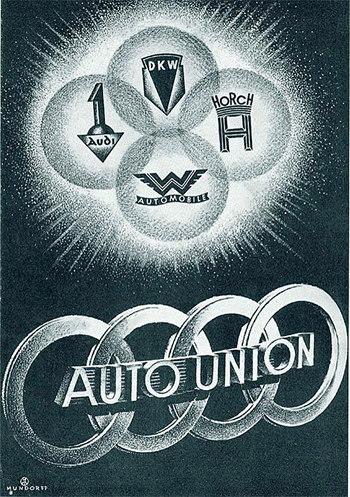
Fast forward to 1985 (skipping a whole lot of history), when Auto Union ultimately became the Audi we know today.
BMW
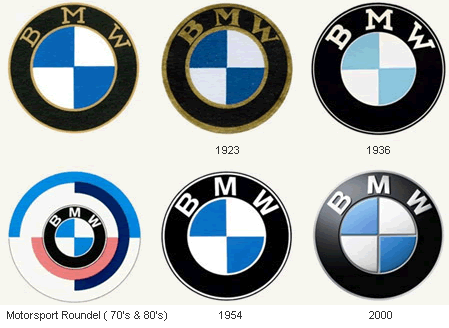
In 1913, Karl Friedrich Rapp and Gustav Otto founded two separate aircraft factories that would later merge to form BMW or Bayerische Motoren Werke AG (Bavarian Motor Works). Rapp and Otto actually had little to do with BMW’s manufacturing of cars. Josef Popp, Max Friz and Camillo Castiglioni were the ones who played big roles in making BMW a modern car manufacturer.
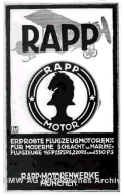
The circular BMW logo was a representation of a spinning propeller of a Bavarian Luftwaffe. At the time, aircrafts were painted with regional colors and the colors of the Bavarian flag were white and blue. It is said that the pilot saw the propeller as alternating segments of white and blue, hence the logo. The roundel was a nod to Karl Rapp’s original company.During World War I, BMW was a major supplier of airplane engines
(and later airplanes such as the Red Baron)
(thanks Redditors!) to the German government. After the war, Germany was forbidden by the Treaty of Versailles to manufacture airplanes and BMW was forced to change its business: it first made railway brakes before making motorized bicycle, motorcycles and cars.
Update 3/6/08: Neatorama readers Dan S. and Bruce Kennedy who pointed out that the idea of BMW logo being derived from spinning propeller was actually an advertisement by the company (scroll down about halfway). Also thanks to klaus who pointed us out to the logo of EMW, which BMW took over in 1928.
Buick
The Buick Motor Company was founded in 1903 by David Dunbar Buick, a Scottish-American inventor who invented the overhead valve engine. If you didn’t recognize the name, you’re not alone – but remember this: Buick, a high school drop out founded a company that later became the world’s largest auto company, General Motors.At 15 years of age, Buick dropped out of school to work for a plumbing fixture manufacturer. When that business failed, Buick and his friend took it over – but within a few years, Buick had an argument with his partner because he preferred to spend his time tinkering with car engines. Buick sold his share in the company and quit.
With the money, Buick founded the Buick Motor Company and within a few years ran it to the ground. He was kicked out of the company by his partner William "Billy" Durant in 1906 and later sold his stock for a mere $100,000. Had he held on to his shares, it would’ve been worth well over $100 million today. In his later years, Buick held low-paying jobs and couldn’t even afford a telephone. He died penniless as an inspector at the Detroit School of Trades. Ironically, years later Durant himself would be forced out. General Motors, the company that Durant built, refused him pension and he died almost penniless. (Source)
Back to the logo story: Early Buick logos were variations of the cursive word "Buick." In 1930s, General Motor Styling researcher Ralph Pew found a description of the Scottish "Buik" [sic] family crest and decided to use it as a radiator grille decoration. In 1960, the logo incorporated three such shields, to represent the three Buick models then built: LeSabre, Invicta, and Electra.
In 1975, Buick changed their logo to a hawk named "Happy" with the launch of their Skyhawk line. However, in the late 1980s, as the Skyhawk car was retired, Buick went back to the tri-shield logo.
Cadillac
When Henry Ford left his second automobile company, Henry Ford Company (see below), his financial backers tried to liquidate the company’s assets. An engineer named Henry M. Leland persuaded them to continue the company instead. They listened, and so Cadillac was born.Cadillac’s first logo was based on a family crest of a minor aristocrat that the company was named after: Antoine de La Mothe, Seigneur de Cadillac (Sir of Cadillac). In 1701, de La Mothe founded Fort Pontchartrain which would later become Detroit. Cadillac was named after de La Mothe in 1902, following a bicentenary celebration of the founding of the city.
Problem was, de La Mothe was never a nobility! Born Antoine Laumet, de La Mothe was forced to leave France for America under a mysterious circumstance (some say he committed a crime or was unable to pay his debt). In the New World, he was able to assume a new identity and cobbled together a famiy crest with elements "borrowed" from, shall we say nobler sources.
In 1998, Cadillac had a new design philosophy called "art and science" and had its logo redesigned. Gone were the six birds called the merlettes, the crown, and the entire fabricated de La Mothe family crest as the company tried to shake up its stodgy image. The new logo made its debut a few years later, looking positively like it was made by Piet Mondrian!
Fiat
Fiat, then named Fabbrica Italiana Automobili Torino (Italian Automobile Factory of Turin), was founded in 1899 by a group of investors, including Giovanni Agnelli who later became its Managing Director. Agnelli bought his shares for $400 (about $10,000 in 2007 money). It’s worth billions now, and there had been an Agnelli in Fiat management ever since. Regardless or perhaps because of its wealth, the Agnelli clan remained a fractious and complicated group of people.Supposedly, the famous Fiat "scrabble tiles" logo of the 1960s was designed by the company’s Chief Designer who was driving past the Fiat factory during a power outage and saw an outline of the factory’s neon sign against the dark sky (Source: The Language of Auto Emblems)
Ford
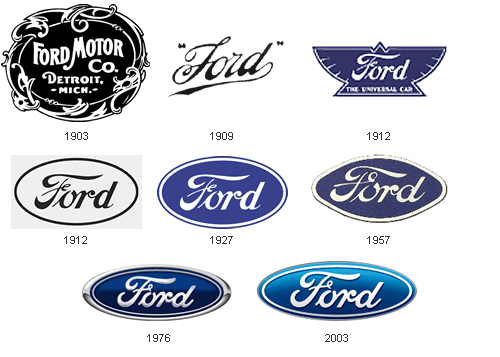
Most people know that Ford was founded by (who else?) Henry Ford. What most people didn’t know was that this was his third automobile company. Ford experimented with cars while working for Thomas Edison, and left to found his first auto company, The Detroit Automobile Company, which went bankrupt in just 2 years. He then built a race car and founded Henry Ford Company. Ford left that one after just one year (the company later became Cadillac – see above).
In 1902, Ford went on to create his third automobile company, the Ford & Malcomson, Ltd., and almost lost that one when sales were slow. He was unable to pay his bills to John and Horace Dodge, who supplied parts. Ford’s partner brought in a group of investors and even convinced the Dodge Brothers to accept shares in the company, which was renamed Ford Motor Company. Later, the Dodge Brothers went on to form their own car company (can you guess what?)
In 1909, Childe Harold Wills, Ford’s first chief engineer and designer (who also help to design the Model T), lend a script font that he created to make his own business card, to create the Ford logo. The famous blue oval was added later for the 1927 Model A – it remained in use until today.
Mazda
Mazda began its life in 1920 as the Toyo Cork Kogyo Co. in Hiroshima, Japan. At the time, there was a cork shortage because of World War I, so the company was founded to process a cork substitute made from the bark of an Abemaki or Chinese cork oak tree. It was a good idea at the time, but shortly afterwards Japan could get real cork again and the company foundered.In 1927, Jujiro Matsuda came onboard and the company began manufacturing tools, three-wheeled "trucks" and then cars. After World War II, the company formally adopted the name Mazda, which depending on who you ask, stood for the Zoroastrian god Ahura Mazda or an anglicized pronunciation of Matsuda the founder’s name (or both).
In the 1936 logo, the M shaped curve was inspired by the emblem of Hiroshima city. The 1991 and 1992 logos symbolized a wing, the Sun and a circle of light. Mazda’s current logo, nicknamed the "owl" logo, was designed by Rei Yoshimara in 1997. The stylized "M" was meant to look like stretched wings, but many people saw a stylized tulip instead.
Mercedes-Benz
The modern Mercedes-Benz traced its lineage to a 1926 merger of two car companies, Daimler-Motored-Gesellschaft or DMG, founded by Gottlieb Daimler (along with Wilhelm Maybach), and Benz & Cie, founded by Karl Benz. Both Daimler and Benz worked independently to invent internal combustion-powered automobiles. Their factories were actually just 60 miles apart, yet they didn’t know of each other’s early work.After World War I, the German economy was in tatters, and to survive, the two companies formed a syndicate in 1924, where they would continue to sell their separate brands but would standardize design, share purchasing and advertising. In 1926, however, the two companies merged into Daimler-Benz.
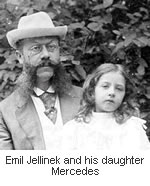
The name "Mercedes" came about in 1900. A wealthy European businessman and racing enthusiast named Emil Jellinek began selling Daimler’s cars. He wanted a faster car, and specified a new engine to be designed by Maybach and to be named after his 10-year-old daughter’s nickname, Mercédès or Spanish for "grace."
"Mercy" (See below)
Jellinek was quite a character. He used to pepper DMG’s engineers with colorful suggestions and criticism such as "Your manure wagon has just broken down on schedule" and "You are all donkeys". However, as he actually sold a lot of cars, he was tolerated and even listened to. Later, Jellinek would add Mercedes to his own and became Emil Jellinek-Mercedes. (Source: My Father Mr. Mercedes by Guy Jellinek-Mercedes and MBUSA Biographies)
The star in Daimler’s logo came from an old postcard where Gottlieb Daimler had drawn a star above the picture of his house and wrote that "this star would one day shine over [his] own factory to symbolize prosperity." The three-pointed star symbolized Daimler’s ambition of making vehicles "on land, on water and in the air." (Source: Daimler)
After the merger, a new logo was designed. It combined the symbols of the two companies: the three-pointed star of DMG and the laurel wreath of Benz.
Update 2/18/08: There’s a dispute on the origin of the name “Mercedes.” According to Baby Names World, Mercedes is a girl’s name of Spanish origin meaning “Mercy.” It was taken from the Virgin Mary’s liturgical title “Maria de las Mercedes” (Mary of the Mercies; ‘Our Lady of Ransom’):
Latin ‘mercedes’ originally meant ‘wages’ or ‘ransom’.
In Christian theology, Christ’s sacrifice is regarded as a ‘ransom for the sins of mankind’, hence an ‘act of ransom’ was seen as identical with an ‘act of mercy’.
Mitsubishi
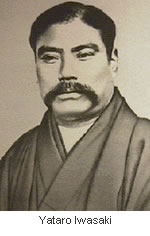
In 1854 feudal Japan, a man named Yataro Iwasaki, son of a provincial farmer whose grandfather sold the family’s samurai status to settle some debt, began his career on the wrong foot: he was called home from school at the age of 19 when his father was injured in a dispute with the village leader. Iwasaki asked a local magistrate to hear his case, and when refused, accused the man of corruption. Iwasaki was promptly jailed for seven months.Fast forward to 1868: Iwasaki was working for the Tosa clan when the Meiji Restoration abolished Japan’s feudal clan system. He acquired Tsukumo Shokai, the Tosa clan’s shipping business and renamed it Mitsubishi in 1873.
It was a fourth-generation Iwasaki, a man named Kayota Iwasaki, who turned Mitsubishi into a giant corporate group that included an automobile manufacturing company, Mitsubishi Motors.
The name Mitsubishi was a combination of the words "mitsu" (three) and "hishi" (water chestnut, used in Japan to mean a rhombus or a diamond shape). The official translation of the name was "three diamonds."
The Mitsubishi logo was a combination of the Iwasaki family crest, three stacked diamonds, and the three-leaf crest of the Tosa Clan.
Peugeot
Peugeot got its start in 1812 in Montbeliard, France, when two brothers, Jean-Pierre and Jean-Frédéric Peugeot converted their windmill into a steel mill. Their first products were rolled steel for saw blades and clock springs, as well as cylindrical steel rods. For decades, the Peugeot family business made metal goods, machine tools, crinoline dresses, umbrellas, wire wheels, irons, sewing machines, kitchen gadgets and by 1885, bicycles.Indeed, Peugeot’s entry into the automobile business was by way of bicycles. At the time, the company was one of the largest bicycle manufacturers in France. In 1889, Armand Peugeot created the company’s first steam-powered car. A year later, he abandoned steam in favor of gas-powered internal combustion engine after meeting Gottlieb Daimler.
The Peugeot "lion" logo was designed by jeweler and engraver Justin Blazer in 1847. It was based on the flag of the Région Franche-Comté. The logo was stamped on Peugeot kitchen gadgets to denote the quality of their steel. It took Armand 14 years to convince his family that cars could be a moneymaker. Only then did they allow him to use the Peugeot lion logo. (Source: Independent)
Now, you may not drive a Peugeot car, but I bet you’ve used a Peugeot invention of 1842: the peppermill. The mill’smechanism was so reliable that it remained virtually unchanged until today.
Renault
Louis Renault was 21 when he made his first car in the backyard of his parent’s home. He soon got orders for cars, so in 1898, along with his brothers and friends, Louis opened the company Société Renault Frères in Boulogne-Billancourt, France.The first Renault logo, drawn in 1900 featured the three initials of the Renault brothers: Louis, Ferdinand and Marcel. In 1906, the logo changed to a front end of a car enclosed in a gear wheel.
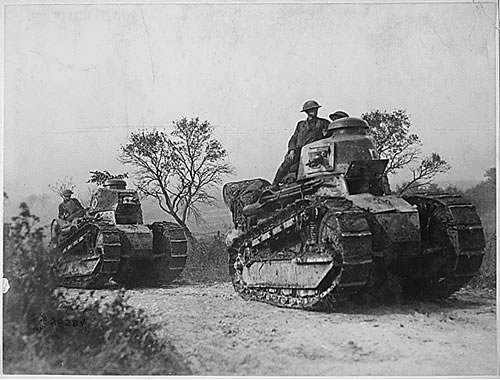
Renault FT-17 tank, driven by American troops, going forward to the battle line in the Forest of Argonne. (Source: The National Archives)
Saab
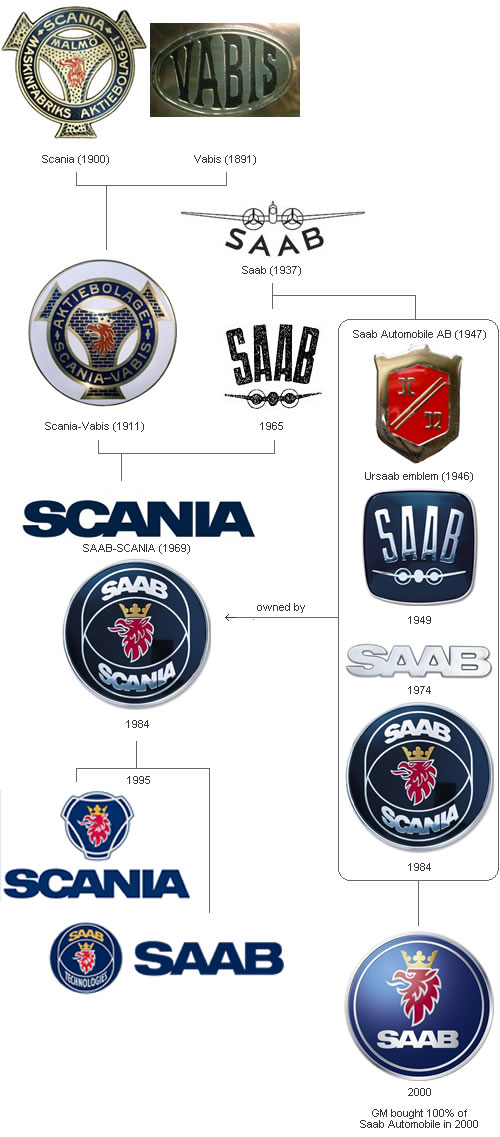
If you’ve ever seen a Saab car commercial, then you’d know that the company was "born from jets". You wouldn’t know it from the car’s staid style, but historically this was accurate: In 1937, an aircraft company called Svenska Aeroplan Aktiebolaget ("Swedish Aeroplane Limited" or simply SAAB) was created to meet the needs of the Swedish Air Force.When World War II ended, SAAB the airplane company started making cars to diversify its business. The first car it made was a prototype called the the Saab 92001 or ursaab (meaning "original Saab") in 1946. It was test-driven for nearly 330,000 miles (530,000 km) in utter secrecy, usually on narrow and muddy forest roads in the early mornings or late nights.
In 1947, the Saab Automobile company was incorporated. The company’s first car was the Saab 92, named because it was simply the company’s 92nd design project (the previous 91 had all been aircraft).
The griffen logo, featuring the head of a mythological beast that had a body of a lion and head and wings of an eagle, came from Vadis-Scania, a truck manufacturer that merged with SAAB (airplane) company. The griffen was a coat of arms of the province Scania.
In 2000, Saab Automobile company was bought out by General Motors, and thus no longer had any connection with SAAB outside of its history and logo similarities.
Confused? Don’t worry about it, just enjoy the pictures.
Volkswagen
You wouldn’t know it from the company’s website but Volkswagen (German for "People’s Car") can trace its history straight to the villain of World War II: Adolf Hitler.Here’s the short version of the story: After World War I, Germany’s economy was shot and cars cost more than most people can afford. When Hitler rose to power and became Chancellor, he spoke at the 1933 Berlin Auto Show of his idea to create a new and affordable car.
At the same time, Ferdinand Porsche (yes, that Porsche) was designing an odd-looking yet inexpensive car (which would later become the Volkswagen Beetle). Porsche met with Hitler in 1934, who asked that the car to have the following specifications: it should have a top speed of 100 km/h (62 mph), a fuel consumption of 42 mpg, and could carry 2 adults and 3 children. He said the car should look like a Maikaefer – a May beetle and even gave Porsche a sketch of the basic design. Porsche promised to deliver the design, with prototype cars to be built by Daimler-Benz.
In 1937, the Gesellschaft zur Vorbereitung des Deutschen Volkswagens mbH was created (it became simply Volkswagenwerk GmbH a year later). In 1938, Hitler opened the state-funded Volkswagen factory in Wolfsburg, which was to produce the KdF-wagen (kraft durch freude, meaning "strength through joy"). Few were actually built, instead, the factory (employing forced labor) churned out military car, based on the same chassis: the Kübelwagen, Schwimmwagen, and Kommandeurwagen.
It was later found out that Hitler had this in mind all along. He added an extra secret specification to Porsche’s design: the car was to be able to carry 3 men, a machine gun, and ammunition.
After Germany was defeated in World War II, the British took over the Volkswagen factory and the KdF-Wagen was renamed the Beetle. The British then sought to give control of the company – first they asked the Ford Motor Company, then the French Government, other British car manufacturers and lastly, Fiat. All turned down this "free offer" because they thought the Beetle’s design was inferior and that the company would be a money drain. (Source: The Auto Channel)
So, the British gave the Volkswagen company back to the German government in a trust. Later, having sold more than 21 million cars, the Volkswagen Beetle would become one of the world’s best selling cars ever.
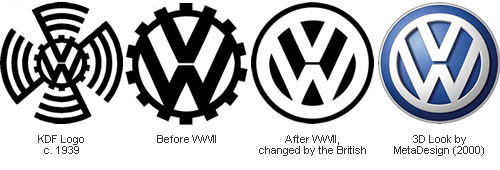
The VW logo itself was supposedly designed by Franz Xavier Reimspiess, an employee of Porsche, during an office logo design competition. He was given a one time payment of 100 Reichsmarks (about $400).
If you didn’t see your favorite car’s logo history, chances are it is because its logo didn’t change much over the years. There are also dozens of large car companies in the world (many more if you counted the defunct ones), and we couldn’t fit every single one in this article. If I missed anything, please let me know in the comment.
by neatorama.com
Subscribe to:
Posts (Atom)